
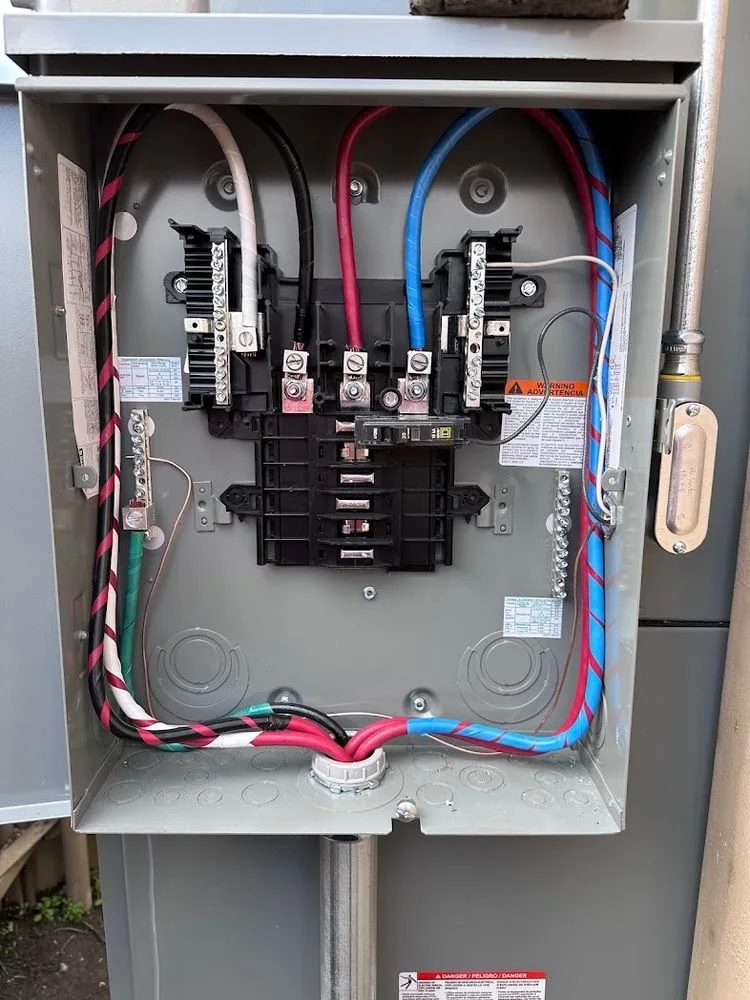
A breaker that will not reset is usually doing one of two things: it has not actually been reset correctly yet, or it is detecting a condition that makes it unsafe to stay on. The important distinction is what the breaker does when you try to reset it — refuse to move to ON at all, move to ON and immediately trip, stay on until you plug something in, stay on for a few minutes and trip again, feel loose or fail to latch, or trip together with a GFCI or AFCI indication. Those patterns point toward different problems. So the question is not “How do I force the breaker back on?” It is why the breaker is refusing to stay on.
One proper reset: fully OFF, then ON. If it will not stay on, stop. The breaker is protecting the circuit or has failed.
Quick answer: what should you do if a breaker won’t reset?
If there is no burning smell, smoke, sparking, unusual heat, or visible panel damage, you can make one basic reset attempt:
- unplug or switch off loads on the affected circuit;
- move the breaker handle fully to OFF;
- then move it firmly back to ON.
If the breaker will not latch, trips immediately, trips again with everything unplugged, or repeatedly trips after reset, stop resetting it. At that point, the circuit needs diagnosis.
If there is burning smell, crackling or sizzling, smoke, visible arcing, a hot electrical panel, or melted plastic, do not keep operating the breaker. Treat the problem as urgent.
Why a breaker won’t reset
A “won’t reset” complaint is often either a handle that was never moved fully OFF, or a protective device that is still seeing a reason to open. Those are different problems.
A breaker often has to go fully OFF before it will reset. This is one of the simplest causes of “my breaker won’t reset.” A tripped breaker may not move all the way to the OFF position by itself — the handle can sit near ON, halfway between ON and OFF, or only slightly out of position. If you push it directly toward ON, it may feel like it will not reset. The normal reset sequence is TRIPPED → fully OFF → ON. That full OFF movement resets the internal mechanism. If it stays on after that and the circuit behaves normally, the problem may have been only the reset procedure. If it trips again, do not keep repeating the process.
The trip is a symptom, not the diagnosis. A breaker is a protective device. Depending on the breaker type, it may respond to overload, short circuit, ground fault, arc fault, or combinations of those conditions. Some breakers also fail mechanically or electrically with age or damage.
What the trip pattern usually means
When the breaker will not stay on, the timing is the first diagnostic clue. An overload that develops after several minutes is not the same problem as a trip the instant the handle moves to ON.
The circuit is overloaded. An overload means the circuit is being asked to carry more current than it is designed to carry for too long. Common examples include using several high-load devices on one circuit — a space heater, hair dryer, microwave, toaster oven, portable air conditioner, vacuum, or power tools. A breaker that trips after several loads are turned on may be responding normally. Unplug high-load devices, reset the breaker once, then reconnect loads one at a time. If the breaker remains on until several devices are operating together, the circuit may simply be overloaded. That does not mean the correct fix is a larger breaker. Breaker size must match the circuit conductors and design. Installing a larger breaker on wiring that is not rated for it can remove the protection the breaker is supposed to provide.
The breaker trips immediately when you reset it. An immediate trip is different from an overload that develops after several minutes. Possible causes include a short circuit, ground fault, damaged appliance, damaged wiring, failed receptacle, faulty switch, hardwired equipment fault, or a breaker problem. If everything accessible is unplugged and the breaker still trips immediately, the fault may be in permanent wiring, lighting, a hardwired appliance, a junction box, a receptacle, a switch, or the breaker. That is the point where homeowner trial-and-error usually stops being useful.
The breaker stays on until one appliance is plugged in. This pattern is extremely useful. Suppose the breaker resets normally, all loads are disconnected, the circuit remains on, one appliance is plugged in, and the breaker trips immediately. That appliance or its cord becomes a strong suspect — a space heater, refrigerator, washing machine, microwave, portable AC, or power tool. Do not keep plugging the same appliance into other circuits to see whether it trips them too. If the appliance appears to be the trigger, stop using it until the equipment is checked.
The breaker stays on for a while, then trips again. A delayed trip can suggest sustained overload, equipment that cycles on later, a motor problem, a heating-element fault, an intermittent wiring fault, or breaker overheating. Examples include equipment that changes operating states: a refrigerator defrost cycle, air conditioner compressor, water heater, washing machine, dishwasher, or pump. The timing matters. Tell the electrician how long the breaker stays on, what equipment is operating, whether the trip happens during startup, and whether it happens only after several minutes. That can narrow the diagnosis significantly.
Faults that keep a breaker from staying on
Short circuits, ground faults, and arc-fault or dual-function protection are not “sensitive breakers.” They are looking for conditions a standard overload trip may not catch.
A short circuit can keep the breaker from resetting. A short circuit occurs when current takes an unintended low-resistance path between conductors. Possible causes include damaged insulation, a pinched cable, a failed appliance, a damaged receptacle, a wiring error, or a loose conductor contacting another terminal. A short can produce a very high current quickly, which is why the breaker may trip immediately. Possible accompanying signs include a pop, a flash, a burned smell, a scorch mark, a damaged receptacle, or a damaged plug. Do not repeatedly reset a breaker after a visible or audible fault.
A ground fault can cause repeated trips. A ground fault occurs when current leaves the intended circuit path and reaches ground or grounded metal. This is especially relevant in bathrooms, kitchens, garages, outdoors, laundry areas, and other wet locations. The protective device may be a GFCI receptacle, a GFCI breaker, or a dual-function AFCI/GFCI breaker. A wet exterior outlet, damaged appliance, or compromised cord can prevent the circuit from remaining energized.
An AFCI breaker may be detecting arcing. Many residential circuits use arc-fault circuit interrupter protection. An AFCI is designed to detect certain electrical arcing patterns associated with damaged or compromised wiring. Possible trip causes include a loose connection, damaged cord, damaged conductor, poor splice, failing device, or certain equipment faults. A breaker marked AFCI is not simply a “more sensitive normal breaker.” It is looking for additional fault conditions. Do not defeat AFCI protection because the breaker trips repeatedly. The cause should be identified.
A dual-function breaker can trip for more than one reason. Some breakers provide both arc-fault protection and ground-fault protection. These are commonly called dual-function breakers. Depending on the model, the breaker may have a TEST button, a trip indicator, a diagnostic LED, or a manufacturer-specific reset procedure. If the breaker has diagnostic indicators, note them before cycling it repeatedly. The model-specific instructions can help identify whether the trip was associated with overcurrent, arc fault, or ground fault.
When the breaker or panel itself is the problem
Sometimes the device that will not stay on is the failed part. That should not be the first assumption, and replacing the breaker without checking the circuit can leave the real fault untouched.
The breaker itself may have failed. Circuit breakers can fail. Possible signs include a breaker that will not latch even with load disconnected, a handle that feels mechanically loose, visible damage, buzzing, burning smell, abnormal heat, or repeated unexplained trips. But a failed breaker should not be the first assumption. Replacing the breaker without checking the circuit can leave a short circuit, ground fault, damaged wiring, or overloaded circuit untouched. A useful diagnosis determines whether the breaker is causing the problem or responding to it.
A loose connection at the breaker can create problems. A conductor connected to a breaker should have a sound electrical termination. A loose or damaged connection can cause heat, buzzing, arcing, intermittent power, discoloration, or a burning odor. A connection can overheat without producing the exact current pattern needed to trip a standard breaker immediately. Do not remove the panel cover or tighten breaker terminals yourself unless you are qualified to work inside energized electrical equipment.
A damaged panel bus can affect the breaker. The breaker connects to conductive parts inside the panel known as the bus. If that connection is burned, loose, corroded, or damaged, the breaker may no longer make a proper electrical connection. Possible symptoms include heat, buzzing, intermittent power, visible breaker damage, and repeated failure. In that situation, replacing the breaker alone may not be enough. The electrician needs to inspect the panel connection itself.