
On this page 5 sections
A panel upgrade starts from arriving load, not a broken panel
An upgrade starts from arriving load rather than from anything being wrong. A charger, a heat pump, an ADU or a shop circuit asks more of the service than it was sized for. The question is whether the house needs more capacity — the answer can be no — and if it does, whether that is breaker spaces, a subpanel, or the service itself.
A large new load arriving
A charger, heat pump, AC or induction range asks more of the service than a house of its era was sized for.
No usable spare spaces
A full panel, or spaces of the wrong kind, is a spaces problem — which is not always a bigger-service problem.
An ADU, garage or shop
A new living or working space needs its own supply, which may be a subpanel rather than a service change.
Several additions at once
Sizing for a charger, a heat pump and an ADU together costs less than sizing for each of them in turn.
A panel upgrade is a capacity question, not a broken panel
A crowded panel and a service too small for the house are different problems with different answers, and only one of them involves the utility. The plan starts by telling them apart.
-
What the service can carry
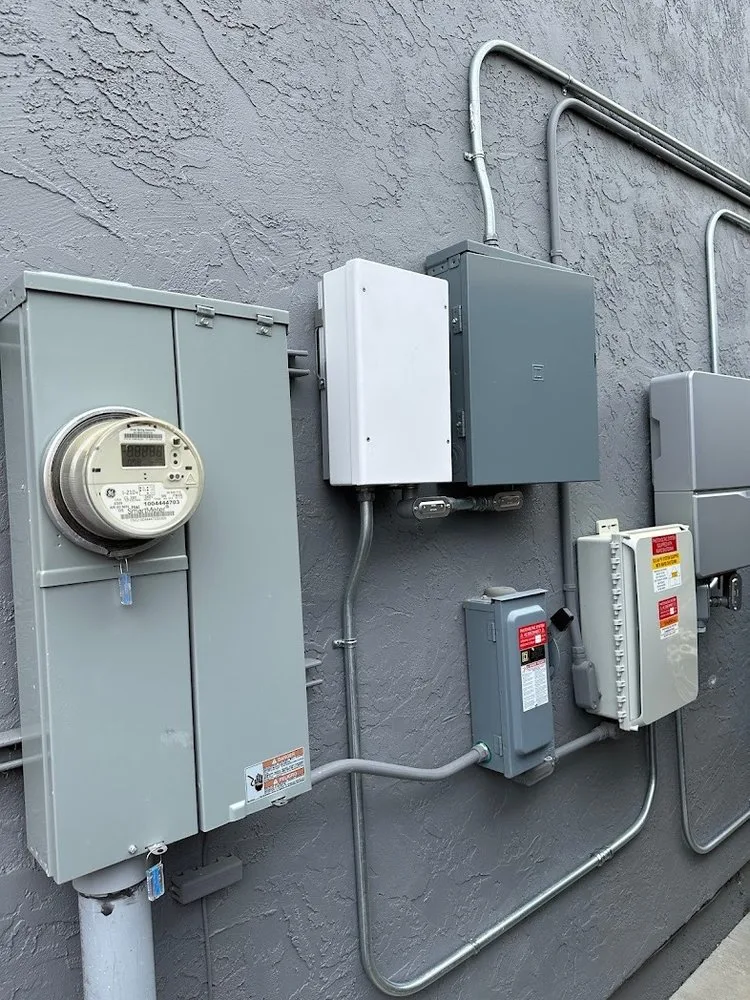
The main disconnect and the meter say what it is rated for; what the property draws is measured rather than assumed. A panel with no spare spaces on a service with capacity to spare is a subpanel job. A service that has run out is a 200-amp service upgrade.
-
What is arriving, and when
A charger, a heat pump, a kitchen or an ADU each ask a different amount. Sizing once for everything on the list costs less than sizing twice, which is the main reason to name the later items now rather than after.
-
A garage or a detached structure
An attached garage is usually a subpanel. A detached garage is a garage subpanel — its own electrode and feeder. Neither is automatically a 200-amp upgrade.
-
Whether the service itself has to change
Breaker spaces and a subpanel stay on the property. If the home needs more capacity, that increase is the 200-amp service upgrade — panel, service entrance, meter equipment, and usually the utility. This job is the decision of whether you need it.
-
If the panel itself is the problem
Heat, damage, or equipment nobody makes breakers for is a panel replacement. This job is the capacity decision.
What we check before sizing your panel upgrade
What the service is rated for, from the main disconnect and the meter
What the property actually draws today, rather than what the panel could theoretically carry
What you are adding, and the manufacturer figures for it
Whether the answer is breaker spaces, a subpanel, or a change to the service
Whether the utility has to be involved, which the service decides rather than the panel
What helps before your panel-upgrade visit
List everything being added, including anything planned for later that could be sized for now
Find the model and the nameplate figures for the equipment — a charger and a heat pump are not interchangeable numbers
Photograph the main breaker or the meter so the existing rating can be read
Do not buy panel components before the existing service has been looked at
Panel upgrade: what changes the cost
An upgrade is priced from what it takes to carry the new load — breaker spaces, a subpanel, or the service itself.
-
Spaces, a subpanel, or a service change
The biggest fork. Adding breaker spaces or a subpanel is work inside the property. Increasing service capacity is a 200-amp service upgrade — and usually involves the utility.
-
Whether the utility is involved
A service change usually means the utility disconnects and reconnects once the inspection clears. Work that stays inside the panel does not.
-
How much new load is arriving
Sizing for one charger is different from sizing for a charger, a heat pump and an ADU at once — and doing it once is cheaper than twice.
-
Location and access
Working at the existing position is simpler than relocating equipment or opening finished surfaces to reach the service.
-
Permit and grounding corrections
The installation is checked against what the permit requires at the address; corrections needed for approval become part of the work.
Not sure this is the right job?
Tell us what you are seeing — what is tripping, what changed, or what you are planning — and we will tell you what the work actually is before anyone drives out.
Panel upgrade questions, answered
Is an upgrade always a bigger service?
No. This job asks whether you need more capacity — the answer can be no. Often it is breaker spaces or a subpanel. If the home genuinely needs more capacity, that is a 200-amp service upgrade — the increase after the need is established.
My panel is full. Do I need a bigger service?
Not necessarily. A full panel is a spaces problem; a service at its limit is a capacity problem. Spaces without a capacity shortfall is a subpanel. Capacity shortfall is a 200-amp service upgrade. Both get measured before either is proposed.
Can the charger and the panel be planned together?
Yes, and it is cheaper. Sizing the panel once for the charger, the heat pump and anything else on the list beats sizing it twice.
Do I choose the equipment first?
Easier not to. What the existing service can carry narrows the equipment, so the order that wastes least is service first, equipment second.
What if the panel is also in poor condition?
Then it is a panel replacement rather than an upgrade, and the condition decides the scope. Heat at the bus, water damage or equipment nobody makes breakers for belong on that page.
What is a panel upgrade?
An upgrade raises capacity, usually because the electrical load no longer fits your requirements. Adding new appliances, subpanels, dedicated circuits can push older 100amp panels to their limits and require an upgrade. Replacement keeps the same size and changes the equipment.
Is upgrading an electrical panel worth it?
It is worth it when the load calculation is already tight, you are adding large equipment, or the existing panel cannot take the next circuit. For example, if you want to add a Level 2 EV charger, an electric dryer, an induction stove, a heat pump or HVAC swap, and your house is already running near capacity.
How long does it take to do a panel upgrade?
The on-site swap is usually a day of work once the utility and the permit are lined up. Utility coordination can add time before we start working.
Still not sure it is the right job? Call (279) 972-9272 — available 24 hours.Want the detail? Level 2 EV charger
Helpful guides
Level 2 EV charger
Start with parking, charging needs, panel capacity, and the circuit route. The charger itself is only one part of the installation.
Read guide100A vs 200A service
A 200-amp service is not automatically better, and 100 amps is not automatically too small. The right size is a load calculation, not square footage.
Read guideHome addition electrical
New rooms mean new circuits, lighting, HVAC power, and often a subpanel — planned before framing and drywall. Not an ADU clone. Call (279) 972-9272.
Read guide
Serving 19 communities across the Sacramento area
Litel Electric serves homeowners throughout all 19 communities in our service area — from Davis and Woodland to Roseville, Folsom, and Elk Grove.
Get estimate
Tell us what is happening, or what you are planning. We read the details, tell you what else we need to know, and explain the next step before anything is scheduled.
- 01
You send the problem or the plan, with the address if you have it.
- 02
We reply with what it involves and what has to be seen in person.
- 03
Nothing is scheduled, and nothing is priced, until the equipment has been looked at.
- hi@litelelectric.com
- License
- CSLB #1115460 · C-10 electrical