
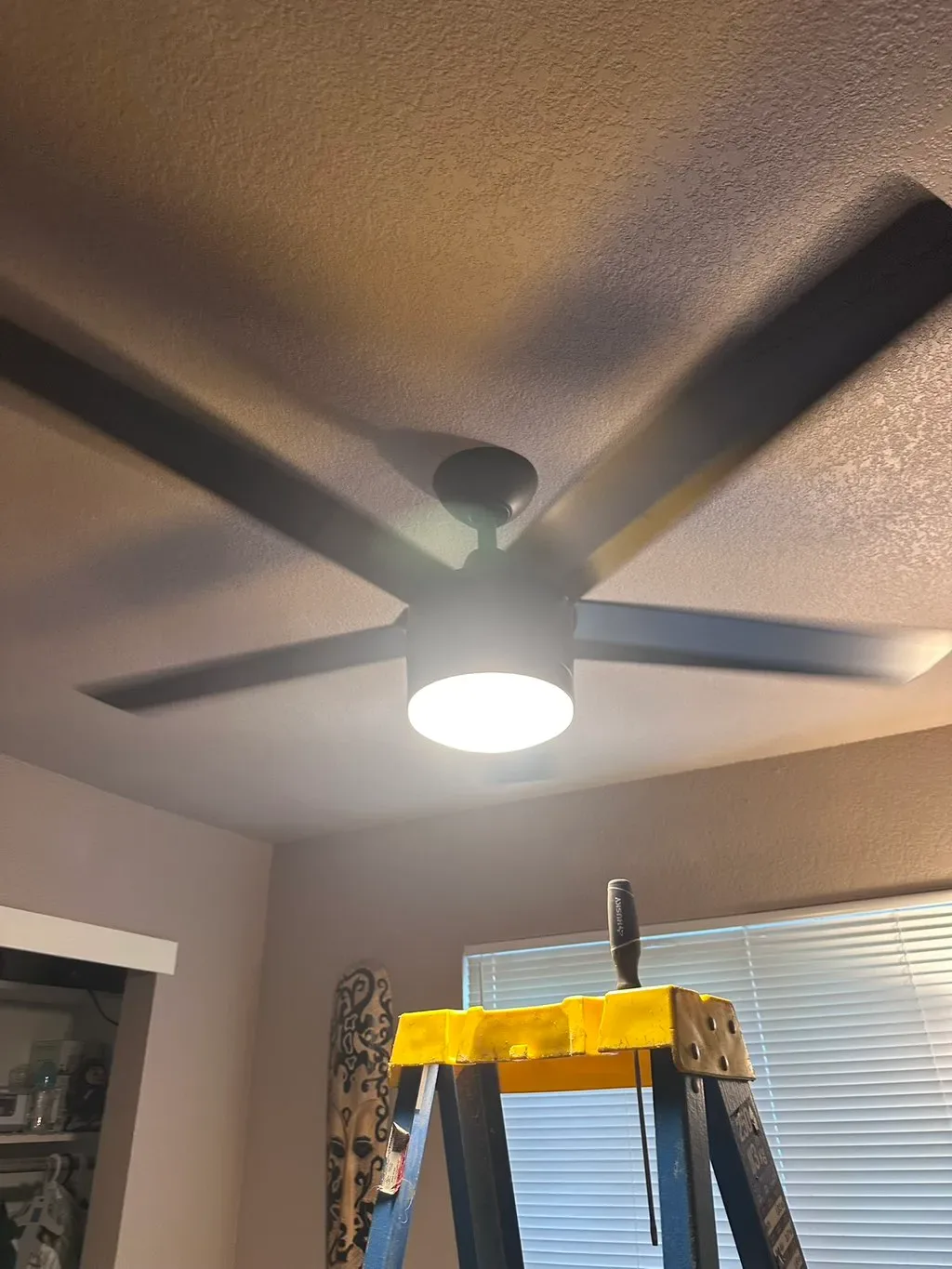
Yes — if the electrical box is being used to support the ceiling fan, it needs to be listed and rated for ceiling-fan support. A normal ceiling light box is not automatically enough. That matters because a ceiling fan does more than hang from the ceiling: it creates vibration, rotational force, repeated movement, and dynamic loading. A box that has safely held a light fixture for 30 years may still be the wrong box for a fan.
The question is not “Does the box feel solid?” It is “Is this box actually listed for fan support, and is it attached to structure in a way that matches the fan’s weight and mounting requirements?” For Sacramento homeowners replacing a ceiling light with a fan, that should be checked before the fan goes up.
listing → weight rating → structure → permit
Ceiling fan requirements at a glance
| Requirement | What to verify |
|---|---|
| Support | If the box supports the fan, it must be listed for ceiling-fan support |
| Markings | “Acceptable for Fan Support,” “Ceiling Fan Rated,” or a stated fan weight rating |
| Weight rating | Current examples include 35 lb and 70 lb; match the actual fan |
| Structure | Joist, approved blocking, or a listed brace — not drywall |
| Circuit | Usually shares a lighting/general-use circuit; a dedicated circuit is usually unnecessary for one normal residential fan |
| Permit | City of Sacramento lists ceiling fans as residential minor-permit work; conventional plans are generally not required |
If the fan is supported by the outlet box, use a box specifically listed for ceiling-fan support. Look for markings such as Acceptable for Fan Support, Ceiling Fan Rated, or a stated fan weight rating. Fan manufacturers commonly instruct installers to use a fan-rated box or another approved structural mounting method. A regular light-fixture box should not be assumed to support a fan just because it is metal, it feels sturdy, it has held a heavy light fixture, or it is screwed into wood.
Why a ceiling fan needs different support than a light fixture
A light fixture is mostly a static load — it hangs in one place. A ceiling fan adds movement. As the motor runs, the mounting system experiences vibration, torque, changes in loading, forces from blade imbalance, and movement from speed changes. That repeated movement is why fan-support boxes and mounting hardware are designed differently. A standard fixture box may be strong enough to hold a light but not listed or constructed for the dynamic load created by a fan.
What is a fan-rated electrical box?
A fan-rated box is an electrical outlet box specifically listed for supporting a ceiling-suspended fan. Depending on the product, it may attach directly to a ceiling joist, to wood blocking, to an adjustable brace between joists, or to another approved structural support. Fan-rated boxes commonly include stronger mounting points, brackets, screws, and structural connections. For example, ABB currently sells fan-rated ceiling boxes with reinforced metal brackets and #10-32 fan mounting screws, with the fan load rating clearly marked inside the box.
The most reliable way to tell is the box markings. Look inside for wording such as Acceptable for Fan Support, Fan Support, Ceiling Fan Rated, or a maximum supported fan weight. Do not rely only on appearance. A fan-rated box may be metal or nonmetallic, round or octagonal, attached directly to a joist or attached to a brace. A standard fixture box can look very similar.
You can sometimes tell from below without removing the box. After the existing light fixture is safely removed, markings may be visible inside, and you may also see substantial fan-support screws, a structural bracket, or a fan-support label. But you should not guess based only on box color, box shape, or how hard it is to wiggle. If the rating cannot be verified, treat the support as unknown until it is identified.
“It feels solid” is not the same as “fan-rated.” This is one of the most common installation mistakes. A homeowner removes a light fixture, grabs the box, and notices that it barely moves. That seems reassuring, but the box may still be a standard light-fixture box, attached with fasteners not listed for fan support, inadequately supported for vibration, or below the fan’s required weight rating. Mechanical stiffness is useful information. It is not a substitute for the product listing.
Metal by itself does not make a box suitable for a ceiling fan. Some metal boxes are fan-rated; some are not. The box still needs to be listed for fan support, mounted correctly, and used within its weight rating. A standard metal octagon box that was installed for a light should not be treated as fan-rated unless its listing and installation support that use.
A plastic box can support a ceiling fan if it is specifically listed for fan support. Modern fan-rated nonmetallic boxes can include reinforced metal brackets, heavy-duty mounting screws, and structural bracing. For example, ABB’s current Carlon fan-rated box is nonmetallic but uses reinforced metal support and is listed for ceiling-fan use. So plastic vs metal is not the real question. The listing and structural installation are.
The weight rating is a maximum supported fan weight, not a generic “fan-rated” stamp. Fan-support boxes can have different maximum fan weights. Examples in the current market include boxes rated for 35 lb fans, 70 lb fans, and other manufacturer-marked limits. The exact rating must be checked on the box. A box suitable for one fan may not be suitable for another — that matters with large decorative fans, oversized outdoor fans, heavy motor housings, large blade spans, and integrated light kits. Do not compare only blade diameter. Check the actual fan weight and mounting instructions.
If the fan weighs more than the box rating, the box cannot be used as the sole support for that fan. The installation may require direct structural support, another listed fan-support system, or mounting directly to framing where allowed by the fan manufacturer. The fan’s weight should be supported by the building structure through an approved method. The electrical box still has to contain the electrical connections appropriately.
Not all ceiling fans hang from the electrical box. Some fan mounting systems allow or require the fan bracket to attach directly to a ceiling joist, wood blocking, or structural framing. The electrical box may then primarily contain the wiring. Hunter, for example, documents fan mounting methods using either a fan-rated box or approved direct attachment to structural support depending on the fan and installation. The fan manufacturer’s instructions control the actual mounting method.
Replacing a ceiling light with a fan
This is where fan-rated boxes matter most. A light fixture may have been installed on a standard plastic ceiling box, a standard metal box, a shallow fixture box, or an old box attached only for fixture support. Do not assume light-fixture location equals fan-ready location.
Before installing the fan:
- Turn off the circuit.
- Remove the old light fixture.
- Identify the electrical box.
- Verify fan-support marking.
- Verify structural attachment.
- Compare box rating with fan weight.
- Follow the fan manufacturer’s mounting instructions.
A fan brace is the usual answer when there is no joist at the fan location. A fan brace is a structural support installed between ceiling joists. It allows a fan-rated box to be positioned where there is no joist directly above the desired fan location. Common retrofit braces are designed so they can be inserted through the existing ceiling opening and expanded between joists, which can avoid opening a large section of drywall. A typical brace installation includes an expanding metal bar, structural contact with the joists, a fan-rated box, and fan-support hardware. A brace is commonly useful when replacing a light whose box is not fan-rated, there is no joist directly above the box, the desired fan position falls between joists, or an old-work installation needs reinforcement without major ceiling demolition. A brace is not automatically necessary if the fan box is already properly mounted to a joist, approved blocking, or structural framing. The right support depends on what is above the ceiling.
If there is no ceiling box at all, that is a larger project than replacing an existing fan. A new fan location may require a new fan-rated box, structural brace or framing support, new electrical cable, a wall switch or control, and circuit evaluation. It may also require electrical permitting in Sacramento.
Drywall cannot support a ceiling fan. The fan support has to transfer the load to framing, a brace, or other approved structural support. The ceiling finish simply surrounds the installation. Do not use drywall anchors, toggle bolts into drywall alone, or standard fixture hardware as the primary support for a ceiling fan.
You can sometimes screw the fan bracket directly into a joist if the fan manufacturer’s approved mounting method allows it. Certain fan systems permit the mounting bracket to be secured directly to structural framing. The electrical connections must still be contained in an approved electrical box. Do not improvise a direct-joist installation without following the actual fan instructions.
Use the screws supplied or specified for the fan-support box and fan mounting system. Fan-rated boxes often use stronger mounting screws than ordinary fixture hardware. Some current fan-rated boxes use #10-32 screws specifically intended for ceiling-fan support. Do not substitute drywall screws, random wood screws into box tabs, or undersized fixture screws. The support system is only as strong as its weakest connection.
Do not automatically reuse the screws from the old light fixture. Light-fixture screws may not match the fan box’s required support hardware. Use box manufacturer hardware, fan manufacturer hardware, and the specified screw size and type. The fact that a screw fits the threads does not prove it is the correct fan-support fastener.
Replacing an existing ceiling fan with another fan can be a smaller scope than adding a new fan where none existed. A strict like-for-like replacement is often simpler, but the support should still be verified if the existing box rating is unknown, the new fan is heavier, the mounting hardware changes, or the previous fan was installed improperly. Do not assume the old installation was correct simply because it stayed up.
Replacing a light with a fan is the installation where support verification matters most. The likely scope can include removing the light, inspecting the box, replacing it with a fan-rated box if needed, adding a brace or structural support, connecting the fan, configuring controls, and inspecting permitted work. Do not hang the fan from the old light box until the box is identified.
Adding a fan where there is no fixture can require a new box, brace, new wiring, a switch, a new circuit connection, attic access, and drywall access. The best installation method depends heavily on whether there is accessible attic above, a joist at the desired location, a finished floor above, or a vaulted ceiling.
A fan-rated box can often be installed without opening a large section of ceiling. Retrofit fan braces are designed specifically for finished ceilings. The electrician may be able to remove the old fixture box, insert a brace through the existing opening, expand it between joists, attach the fan-rated box, and install the fan. Not every ceiling allows this. Access conditions determine how invasive the work becomes.
Why wobble, weight, and ceiling shape matter
A properly installed fan should not have excessive wobble. Possible causes include blade imbalance, a bent blade holder, loose mounting hardware, poor downrod installation, inadequate support, or a damaged fan. Minor movement can occur in some fans, especially on long downrods. But substantial or increasing wobble should be investigated. The support should not be allowed to loosen gradually from repeated motion.
A wobbling fan does not necessarily mean the box is bad. Common causes include unbalanced blades, blade brackets not aligned, loose blade hardware, bent components, or an improperly seated downrod ball. But the mounting box and structural attachment should be checked if the fan moves at the ceiling, the canopy shifts, the bracket moves, screws loosen repeatedly, or the ceiling cracks around the box. Do not keep running a fan with obvious mounting movement.
Heavy ceiling fans need more attention. Large modern ceiling fans can be substantially heavier than basic builder-grade fans — 60-inch+ fans, decorative wood-blade fans, oversized great-room fans, outdoor patio fans, and heavy integrated light systems. Before installing one, confirm fan weight, box weight rating, mounting method, structural support, ceiling slope, and downrod requirements. A fan-rated box is not automatically rated for every fan.
Large blade spans do not automatically require a stronger box. The important factors are actual fan weight, mounting design, dynamic forces, and manufacturer instructions. A lightweight 72-inch fan and a heavy 52-inch decorative fan may have very different support requirements. Use the actual specifications.
A sloped or vaulted ceiling adds other considerations: fan canopy compatibility, a slope adapter, downrod length, blade clearance, and structural mounting angle. The fan support still needs to be properly rated and attached. Do not rely on the ceiling angle to determine box type. The support method needs to match the fan system.
A long downrod can increase visible movement, which makes correct mounting even more important. Check the fan manufacturer’s maximum downrod recommendations, ball-and-socket seating, set screws, structural support, and blade clearance. A long downrod does not change the need for a proper fan-support system.
Ceiling height matters for comfort and clearance. A fan mounted too low can create head-clearance issues, poor room circulation, and visual crowding. A fan mounted too high may circulate air less effectively. Use the manufacturer’s installation height requirements and applicable building/electrical clearances. Low-profile fans may be better for lower ceilings.