
EV charging

Can my electrical panel handle an EV charger?

A Level 2 charger does not automatically mean a new panel or 200 amps. How much charging you need, and what the service can carry, decides it.

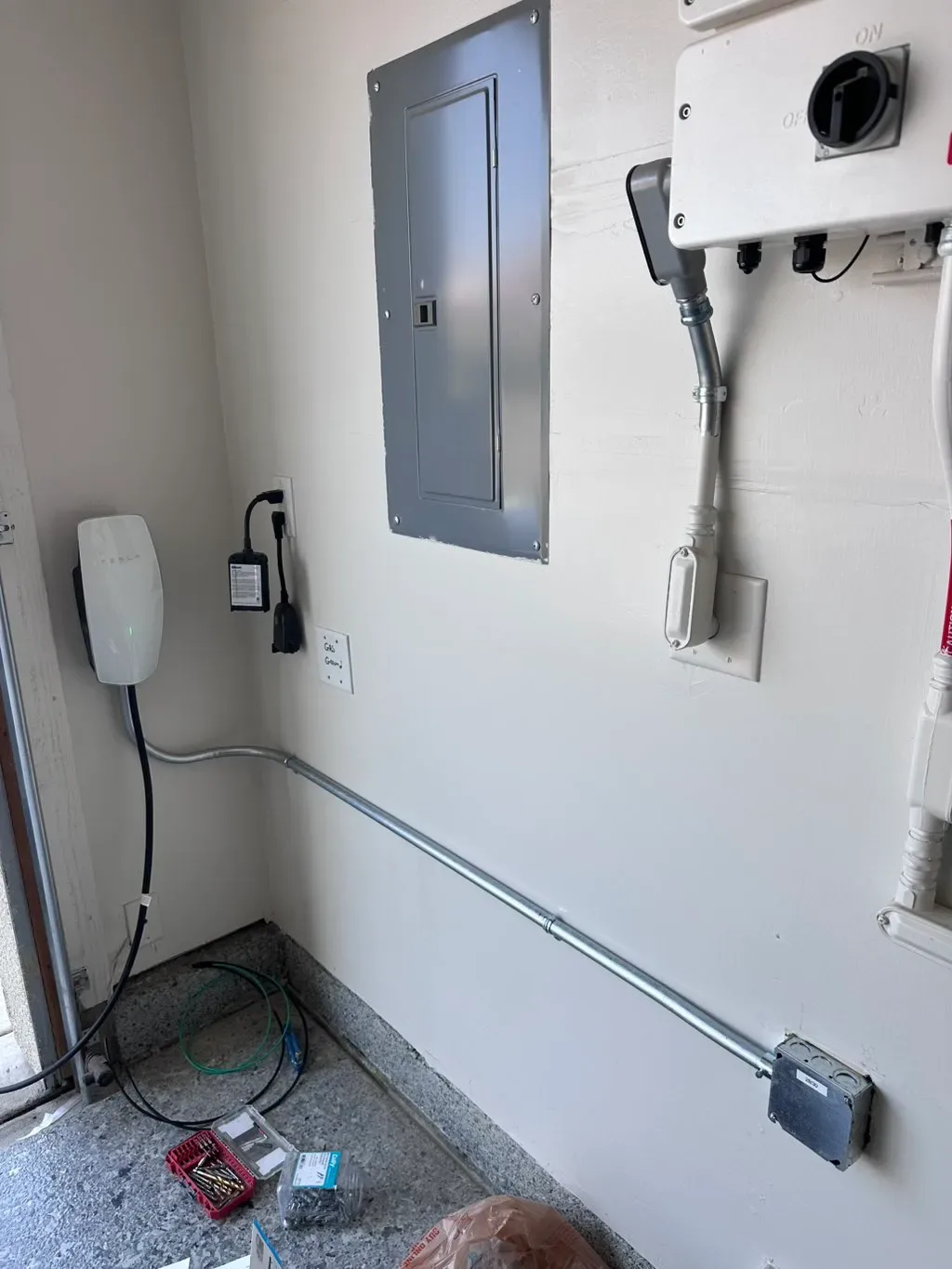
Home EV charger installed by Litel Electric in a Sacramento garage

Available 24 hours

Licensed C-10 · CSLB #1115460

Emergency electrical
10 sections
  1. At a glance
  2. Service rating
  3. The load calculation
  4. A 100A panel
  5. Not the fastest charger
  6. Not enough capacity
  7. Breaker space
  8. Beyond the first EV
  9. What SMUD says
  10. Before an estimate

Installing a Level 2 EV charger does not automatically mean you need a new electrical panel or a 200-amp service. Some homes have plenty of unused electrical capacity. Others are close to their limit. In between, there are homes where an EV charger can work without a service upgrade if the charging rate is reduced or an approved energy-management system is used.

The useful question is:

How much charging power do you need, and can the existing electrical system supply it safely?

That takes more than looking at the number on the main breaker.

Level 2 EV charger load at a glance

Configured charger outputTypical circuitCapacity note
16A20AOften enough for predictable daily mileage overnight
24A30ALower than vehicle maximum when the service is tight
32A40ACommon when 48A/60A would force a service upgrade
40A50AContinuous-load sizing; the circuit is larger than the charger output
48A60AVehicle maximum is not a house requirement

A 100A service can support EV charging in some homes. A 200A panel is not automatically enough. Panel space and service capacity are different problems. SMUD currently identifies circuit-sharing and energy-management devices as alternatives to a panel upgrade in suitable installations.

“Level 2 charger” describes a broad category, not one fixed electrical load. Residential Level 2 equipment can be set to different output levels (the table above), so the circuit is sized for the charging equipment and installation method, not for “a Level 2 charger” in the abstract.

EV charging is generally treated as a continuous load because a vehicle may charge for three hours or more. That means the circuit is sized with additional capacity rather than simply matching the charger’s output amperage. A 40-amp charger, for example, is normally installed on a 50-amp circuit.

A car that can accept 48A charging does not mean your house must provide 48A charging. Many drivers can replenish their normal daily mileage overnight with substantially less.

Service rating is not spare capacity

Look at the main breaker if it is safely visible without removing the panel cover. Common residential ratings include 100A, 125A, 150A, and 200A. The main-breaker number is only the beginning. An electrician may also need to verify service conductors, meter and service equipment, panel rating, upstream disconnects, panel condition, available breaker spaces, grounding and bonding, and existing large electrical loads.

A 200A-rated panel does not necessarily mean the house has a 200A service. Likewise, a 100A service is not automatically incapable of supporting EV charging.

“I have a 200A panel” is not enough. Two houses with 200-amp services can have completely different amounts of spare capacity. One home with a gas furnace, gas water heater, gas range, gas dryer, conventional air conditioning, no spa, and no major workshop loads may have substantial capacity available. Another with an electric heat pump, electric water heater, induction range, electric dryer, pool equipment, spa, and an accessory dwelling unit may already use much more of the available service capacity. The service rating tells you the ceiling. It does not tell you how much of that ceiling is already spoken for.

The load calculation is the test

Before deciding that a service upgrade is necessary, the home’s electrical load should be evaluated. A residential load calculation considers general lighting and receptacles, kitchen small-appliance circuits, laundry, range or cooktop, dryer, water heater, HVAC, fixed appliances, spa or pool equipment, existing EV charging, and other large electrical loads. The proposed charger is then added according to the applicable calculation rules.

This is different from adding together the numbers printed on all the breakers. A 200A panel can easily contain branch breakers whose ratings total far more than 200 amps. That is normal because every circuit is not expected to operate at maximum load simultaneously.

A 100A panel can support an EV charger

Yes, in some homes. A smaller house with gas heating, gas water heating, gas cooking, a gas dryer, and modest air-conditioning load may still have enough calculated capacity on a 100A service for a Level 2 charger. Another 100A home with electric HVAC, electric water heating, electric range, and electric dryer may be pushed beyond available service capacity by the same charger. The service rating alone cannot settle the question.

You may not need the fastest possible charger

Charging speed should be based on how the vehicle is actually used. Suppose the car normally returns home with 30 or 40 miles of driving to replenish and spends eight, ten, or twelve hours parked overnight. Maximum-rate home charging may provide little practical benefit. A lower charging rate can sometimes fit within the existing service capacity, use a smaller circuit, reduce installation cost, and avoid unnecessary service work. This is especially relevant when the vehicle is driven a predictable daily distance rather than arriving nearly empty every night.

Next step

Check the panel before you buy

Send a photo of the panel with the door open, where the car parks, and the charger rate you want. Those three settle most of the job.

What if the panel does not have enough capacity?

A service upgrade is only one of several possible answers.

Install the charger at a lower amperage. Many hardwired EV chargers can be configured for a lower maximum output. For example, instead of designing around 48A charging on a 60A circuit, the installation might use 32A charging on a 40A circuit if that better matches the house and the driver’s needs. The exact setting must match the charger, circuit, wiring, and installation requirements.

Use an energy-management system. An energy-management device can monitor the home’s electrical demand and control EV charging so the main service is not overloaded. When household demand is high, the system can reduce or temporarily stop charging. When household load falls, charging resumes. SMUD specifically identifies energy-management devices as an alternative that can sometimes avoid a panel upgrade. This is particularly useful because the EV usually has many hours available to charge. It does not necessarily need full output while the oven, dryer, HVAC system, and other large loads are operating.

Use a circuit-sharing device. In some installations, a listed circuit-sharing device can allow an EV charger and another appliance to share an existing circuit. A common example is an electric dryer. The device prevents both loads from operating on the circuit at the same time. When the dryer is running, charging pauses. When the dryer stops, the charger can use the circuit. SMUD currently recognizes circuit-sharing devices as another potential alternative to a panel upgrade and offers incentives for qualifying equipment. This is not the same as simply plugging two high-load appliances into a splitter. The equipment has to be specifically designed and installed for the application.

Upgrade the service. Sometimes the existing system genuinely does not have enough capacity. A service upgrade becomes more reasonable when the calculated load is already close to the service rating, the home is also adding other major electrical loads, the existing service equipment needs replacement anyway, future electrification is planned, or load management would create an unnecessarily constrained installation. In those cases, moving from 100A or 125A to 200A may make sense.

Breaker space and obsolete panels

A panel can have enough electrical capacity but no physical space for another breaker. It can also have open breaker spaces but insufficient service capacity. Those are different issues. If breaker space is the only problem, possible solutions can include using breaker arrangements permitted by the panel manufacturer, adding a subpanel, or replacing the panel with a larger distribution panel. That does not automatically require increasing the home’s service amperage. Conversely, an empty breaker position does not prove that the service can support another 40A or 60A load.

Federal Pacific and Zinsco panels change the question. The EV charger may expose a second decision that was already waiting to be made. If the home has obsolete equipment such as an FPE Stab-Lok or Zinsco panel, the question is not simply whether another breaker physically fits. The electrician should evaluate whether adding a substantial continuous load to that equipment is an appropriate long-term installation. If panel replacement is already warranted, that is also the time to determine whether the existing service size should remain or be increased. Do not assume those are the same decision. A homeowner could reasonably need panel replacement at the existing service size, panel replacement plus a service upgrade, or panel replacement plus load-managed EV charging. The correct scope depends on the existing system and future loads.

Think beyond the first EV

A charger installation is a good time to ask what else is likely to change: a second EV in a few years, a gas furnace becoming a heat pump, whether the gas water heater is staying, an induction range, an ADU, a spa or sauna, or solar or battery storage. A service that can handle one EV charger today may become restrictive if several of those projects happen later. That does not mean every homeowner should immediately install 200A service. It means the load calculation should include known future plans when practical.

Two EVs do not necessarily mean two full-size circuits. Two-EV households have more options than installing two independent chargers at maximum output. Some charging systems can share a defined amount of available power between multiple vehicles. Instead of allowing two chargers to draw their full output simultaneously, a load-sharing system can divide the available capacity between them. As one vehicle finishes or requires less power, more can become available to the other. For cars parked overnight, this can make much better use of existing electrical capacity than designing both charging points around the theoretical maximum.

What SMUD says about panel upgrades for EV charging

SMUD’s current residential EV guidance directly addresses this question. Its answer to whether a panel upgrade is required for a home EV charger is not necessarily. SMUD identifies both circuit-sharing devices and energy-management devices as alternatives in suitable installations.

As of September 2026, SMUD’s Charge@Home program also lists incentives for qualifying EV charging equipment and up to $200 toward eligible circuit-sharing or energy-management devices. Programs and incentive amounts can change, so check the current SMUD requirements before purchasing equipment.

What to have ready before an estimate

A useful EV-charger estimate should answer more than “charger installation: $X.” Before recommending a panel or service upgrade, the electrician should establish:

  1. Existing service rating — what electrical service the home actually has.
  2. Panel condition and configuration — whether the equipment is suitable for the new circuit.
  3. Available breaker space — whether the charging circuit can be accommodated physically.
  4. Calculated load — how much service capacity is already committed.
  5. Required charging rate — how much charging power the homeowner actually needs.
  6. Installation route — how far the parking location is from the electrical equipment.
  7. Load-management options — whether approved equipment could avoid unnecessary service work.
  8. Future loads — whether the house is likely to add another EV, heat pump, electric water heater, ADU, or other major load.

Only after those questions are answered does “Do you need a panel upgrade?” become a useful question.

Without removing any covers, photograph the entire electrical panel, a clear view of the main breaker, the panel label if visible, a wider shot of the panel location, the proposed charger location, and the likely path between the two. Also provide the vehicle make and model, charger model if already selected, approximate daily driving, whether a second EV is expected, and any major planned electrical upgrades. Do not remove the panel deadfront to photograph the interior.

EV charger panel capacity in Sacramento

Your panel can handle an EV charger if the electrical system has enough usable capacity for the charging load you actually need. That does not require a 200A service in every home.

A proper evaluation can lead to several different answers: install the desired charger normally, install it at a lower output, use energy management, use an appropriate circuit-sharing arrangement, replace an obsolete panel without changing service size, or upgrade the electrical service. The expensive answer should not be the default answer.

For a Sacramento-area home, Litel Electric can verify the existing service and panel, calculate the load, review the intended vehicle and charging rate, and determine whether the charger can be installed on the existing electrical system before recommending a panel or service upgrade.

See EV charger installation.

Call (279) 972-9272.

Sources

Get estimate

Tell us what is happening, or what you are planning. We read the details, tell you what else we need to know, and explain the next step before anything is scheduled.

  1. 01

    You send the problem or the plan, with the address if you have it.

  2. 02

    We reply with what it involves and what has to be seen in person.

  3. 03

    Nothing is scheduled, and nothing is priced, until the equipment has been looked at.

License
CSLB #1115460 · C-10 electrical