
Lighting

Christmas light installation in Sacramento: what to know before you hire

Holiday lights are an electrical job before they are a decorating one. GFCI, outdoor circuits, and a timer — then the roofline. Call (279) 972-9272.

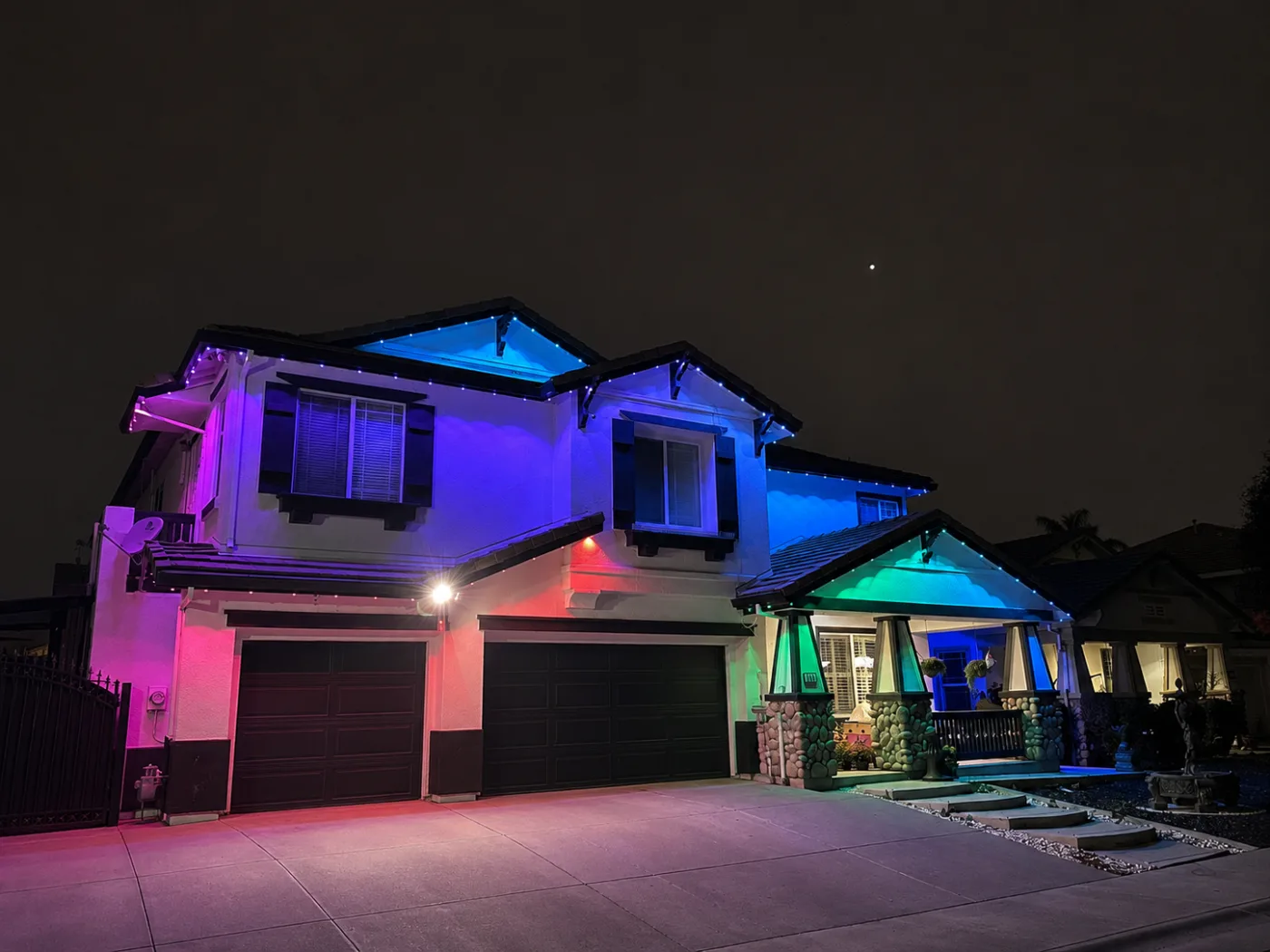
A two-story Sacramento home with its rooflines lit in color-changing LED for the holidays

Available 24 hours

Licensed C-10 · CSLB #1115460

Emergency electrical
10 sections
  1. Installer or electrician
  2. Start with the house
  3. Outdoor-rated gear
  4. How many lights
  5. Safe mounting
  6. Timers
  7. Seasonal vs permanent
  8. Cost and quotes
  9. Inspect first
  10. Commercial properties

Searching for Christmas lights installation near me in Sacramento usually starts with a simple goal: the house lit for the holidays without a weekend on a ladder. Professional Christmas light installation can mean very different things depending on the company. One installer may simply hang lights you already own; another may provide custom design, commercial-grade lights, roofline installation, tree and shrub wrapping, timers and controls, in-season maintenance, post-holiday takedown, and storage until next season.

And sometimes the real problem is not hanging the lights at all. It is the electrical system supplying them. If outdoor receptacles are ungrounded, the GFCI keeps tripping, extension cords are crossing the yard, or the display is large enough to overload an existing circuit, an electrician may need to solve that part before the decorating crew arrives. Planning it well means knowing how to lay out a Christmas light installation, what to ask before hiring, and when the electrical side deserves more attention.

The planning order is:

house power → GFCI → outdoor-rated lights and cords → circuit load → timer → installer vs electrician
ItemCurrent planning baseline
Outdoor powerConnect outdoor holiday lights to GFCI-protected receptacles
EquipmentOutdoor-rated lights and outdoor-rated cords
Circuit loadWattage of the strings plus other loads on the same circuit
Dedicated circuitNot needed for most modest displays
Extension cordsTemporary; outdoor-rated only
TimerControls when the display runs; does not increase circuit capacity
Permanent lightingA different project from seasonal hang
Installer vs electricianDecorative hang vs new outlets, GFCI, circuits, or permanent wiring
SprinklersDo not hang lights, decorations, or cables from sprinkler piping or heads

A full-service holiday lighting company may handle design, measurement, lights and clips, installation, tree wrapping, timers, in-season troubleshooting, takedown, and storage. Sacramento-area installers currently advertise combinations of those services rather than installation alone. Quotes should be compared by scope, not just by total price. A lower quote may assume you provide the lights and handle takedown. A higher quote may include the complete seasonal system.

Christmas light installer or electrician?

These are not the same service.

A Christmas light installer is usually the right choice for roofline lights, tree wrapping, shrubs and landscaping, decorative design, temporary clips and mounting, seasonal installation, takedown, and storage.

An electrician is the right choice when the project needs a new outdoor receptacle, a new branch circuit, GFCI protection, repair of a dead outdoor outlet, correction of an open ground, troubleshooting repeated GFCI trips, overloaded circuit diagnosis, permanent wiring, hardwired lighting equipment, or service or panel work.

A decorating crew should not be modifying permanent household wiring unless they are properly qualified and permitted to do that work.

Start with the house, not the lights

Before selecting bulb colors or roofline patterns, identify where the display will actually get power. Walk around the exterior and locate outdoor receptacles, garage receptacles, porch receptacles, GFCIs, exterior switches, existing landscape-lighting power, and the panel location. Then compare those locations with the areas you want illuminated. A beautiful roofline plan becomes awkward quickly if the only usable outdoor receptacle is on the opposite side of the house.

Outdoor Christmas lights should be GFCI-protected. Outdoor holiday lighting is exposed to rain, irrigation, wet soil, condensation, damaged cords, and exterior metal surfaces. The U.S. Consumer Product Safety Commission recommends that outdoor holiday lights and decorations be connected to GFCI-protected receptacles. A GFCI monitors current leaving and returning on the circuit; if enough current leaks from the intended electrical path, the device shuts off power. For Sacramento homeowners, this is one of the first things worth checking before a large outdoor display is installed.

If the outdoor outlet is not GFCI-protected, do not simply install a larger extension-cord network around it. The electrical system should be evaluated. Depending on the existing wiring, possible solutions can include installing a GFCI receptacle, providing GFCI protection upstream, repairing existing GFCI protection, or adding a new outdoor circuit. The correct approach depends on the circuit and current code requirements.

If the GFCI keeps tripping when the Christmas lights are on, the device is not necessarily defective. Possible causes include moisture in a plug connection, a damaged light string, a damaged extension cord, a wet outdoor connection, a defective decoration, a downstream wiring problem, or cumulative leakage from many connected devices. If the GFCI stays reset with the lights disconnected but trips when one part of the display is connected, that section becomes a strong suspect. Do not replace the GFCI with an unprotected outlet simply to keep the display running.

Do Christmas lights and cords need to be outdoor-rated?

Lights used outside should be marked for outdoor use. So should extension cords. CPSC holiday-lighting guidance specifically recommends checking outdoor lights for certification for outdoor use and using extension cords rated for their intended environment. Indoor cords are not simply less durable versions of outdoor cords; outdoor cords are designed with jackets and construction appropriate for exterior use.

Inspect last year’s lights before reinstalling them. Holiday lights spend most of the year coiled, boxed, moved, and stored in garages or attics. Before installation, inspect them for frayed wire, cuts, exposed conductors, cracked sockets, damaged plugs, loose connections, and missing protective parts. The City of Sacramento Fire Department specifically advises checking holiday lights for worn, frayed, or broken cords and loose bulb connections before use. CPSC gives similar guidance for both new and older sets. A damaged light string should not go back onto the roof simply because it still lights up.

LED Christmas lights make larger displays easier. Modern LED holiday lights generally use much less power than older incandescent Christmas lights, which can make it easier to build a substantial display without placing as much load on the circuit. Other advantages can include lower heat output, longer lamp life, more strings per designed system, and less electrical demand. But LED does not mean unlimited. The manufacturer still specifies maximum connected strings, current ratings, indoor/outdoor use, and connection method. Follow the product specifications rather than estimating based on the circuit breaker alone.

How many Christmas lights can one circuit handle?

There is no reliable answer based on the number of bulbs alone. You need to know the wattage of each string, the number of strings, other equipment on the same circuit, the circuit rating, and manufacturer connection limits. LED sets can vary widely. A professional installer should understand the connected load rather than simply continuing to add strings until something trips. If a large display repeatedly trips a breaker, the correct response is not to replace the breaker with a larger one. The circuit needs to be evaluated.

One outlet can be on the same circuit as several other things. An exterior receptacle may share a circuit with garage outlets, a bathroom outlet, interior receptacles, a freezer, a garage door opener, exterior lights, or another outdoor receptacle. That means the holiday display is not necessarily the only load on the circuit. If the display works until another appliance starts, shared circuit loading may be part of the problem. An electrician can identify which outlets share the branch circuit and whether a dedicated circuit is justified.

Most modest holiday displays do not need a dedicated circuit. A dedicated exterior circuit becomes more reasonable when the display is large, existing outdoor circuits are already heavily loaded, multiple GFCI trips or breaker trips occur, holiday displays are installed every year, permanent architectural lighting is planned, exterior receptacle locations are poor, or several high-load decorations are used. The circuit should be designed around the actual load and intended use.

How should outdoor lights be mounted safely?

CPSC recommends securing outdoor holiday lighting to firm supports and avoiding mounting methods that damage wiring. Temporary roofline lighting is commonly installed with purpose-made clips rather than nails through wire, staples crushing insulation, screws through light strings, or improvised metal fasteners. The goal is to support the lights without damaging the conductors or roof. A professional installer should also avoid creating a roof-maintenance problem just to keep a bulb line straight.

Do not run Christmas lights near overhead service wires. Some Sacramento homes have overhead electrical service, which means the utility service conductors may pass near eaves, roof edges, trees, and upper-story decorations. CPSC specifically warns people decorating outdoors to stay away from power and feeder lines. A roofline display is not worth working near energized service conductors. If the proposed lighting area is close to utility wiring, change the design or use a qualified professional who can identify the hazard.

Tree wrapping needs more planning than it looks like. Tree lighting is one of the most labor-intensive parts of a Christmas display. The installer has to consider tree height, trunk diameter, branch structure, access, cord routing, growth, weather, and removal. A tight wrap may look clean in December but should not become a permanent restriction around a growing tree. Seasonal tree lighting should be removed as planned rather than left indefinitely.

Sacramento weather still matters. Sacramento does not have severe winter weather compared with many parts of the country, but outdoor Christmas lighting still has to deal with rain, wind, wet ground, irrigation, falling branches, and seasonal storms. Connections should not be left where they sit in pooled water or receive direct irrigation. Mounting should be able to tolerate normal seasonal wind without pulling against wiring.

Extension cords should remain temporary. Christmas lighting is a temporary application, which is one of the legitimate uses for extension cords — but temporary does not mean careless. Avoid indoor extension cords outdoors, damaged cords, cords pinched by doors or windows, cords under rugs, cords where vehicles cross them, connections sitting in water, multiple improvised adapters, and cords used as permanent household wiring.

The City of Sacramento Fire Department also identifies extension cords as temporary wiring in its electrical safety guidance. If you need the same long extension-cord path every year, adding an appropriately located outdoor receptacle may be a better long-term solution.

Next step

Get the outdoor circuit ready

Tell us whether outlets outside trip, whether you want seasonal hang or permanent roofline lighting, and how much of the house you want lit.

Should Christmas lights be on a timer?

A timer prevents holiday lights from running all day or remaining on accidentally overnight. Options include a plug-in outdoor timer, a photocell timer, a programmable timer, a smart outdoor plug, or an integrated permanent-lighting controller. The control equipment itself should be listed and appropriate for the environment where it is installed. A timer does not increase the electrical capacity of the circuit. It simply controls when the load operates.

Should Christmas lights be left on all night? The City of Sacramento Fire Department advises unplugging Christmas tree lights before leaving home or going to sleep. CPSC similarly recommends turning holiday lights off when leaving or going to bed. For exterior displays, timers make this much easier: rather than relying on someone to remember every night, the display can shut down automatically.

Seasonal hang vs permanent holiday lighting

Sacramento homeowners increasingly have two different options.

Seasonal Christmas lights are installed before the holidays and removed afterward. Advantages include a traditional appearance, a design that can change each year, no permanent track visible, and a wide choice of bulbs and styles.

Permanent architectural holiday lighting is a track or lighting system that remains installed throughout the year. Advantages can include app control, programmable colors, no annual roofline installation, and use for other holidays and events. Permanent lighting is a different project. It may involve permanent mounting, controllers, power supplies, permanent electrical connections, and dedicated receptacles or circuits. That is where electrical planning becomes more important.

Do permanent Christmas lights require an electrician? It depends on the system. Some permanent lighting products are designed around plug-connected low-voltage systems; others may require more substantial permanent electrical work. If the installation involves a new branch circuit, a new receptacle, a hardwired connection, panel work, or permanent line-voltage wiring, the electrical portion should be handled appropriately and permitted where required. The decorative-light installer and electrician may therefore be separate contractors on the same project.

Cost, quotes, and when to book

There is no useful single price for every property. Current Sacramento installers advertise different service models, from straightforward roofline work to full-service packages that include custom design, lights, installation, maintenance, takedown, and storage. One Sacramento provider currently advertises residential packages starting at $799, but that should be treated as one company’s current starting point, not a Sacramento market price. Actual cost depends heavily on the property and service model.

Roofline length and height drive labor first. A simple one-story roofline is different from a large multi-level home, and second-story and steep-roof work requires more time and access equipment. Design complexity matters next: straight eaves cost less to install than peaks, ridgelines, dormers, columns, and multiple roof planes. Trees and landscaping can require far more labor than roofline lighting when the wrap is dense.

Who owns the lights changes the quote. It may include a contractor-supplied commercial-grade system, homeowner-supplied retail lights, or a leased lighting system. Maintenance may be included as in-season repairs or charged separately. Takedown may be bundled or separate. Storage is something full-service installers may provide until the following season. Ask what is actually included before comparing quotes.

Do not wait until the week before Christmas if you want a particular installation date. Sacramento installers already market and book holiday installations well before December. The busiest period tends to concentrate around the weeks before and immediately after Thanksgiving. If you want custom-cut roofline lights, substantial tree wrapping, commercial installation, or a specific pre-holiday date, booking earlier gives the installer more flexibility.

A clear Christmas light installation estimate should identify design scope, roofline areas, trees and shrubs, lights supplied, color and bulb style, clips and mounting method, extension cords, timers, installation date, maintenance, takedown, storage, and ownership of the lighting materials. Ask what happens if a string fails, a GFCI trips, wind damages a section, a bulb goes out, or the homeowner adds another decoration. A complete seasonal service should define those situations before December.

Before hiring, ask:

  1. Do you provide the lights or install mine?
  2. Are the lights rated for outdoor use?
  3. Do you include timers?
  4. How do you attach lights to the roofline?
  5. Do you install on second-story or steep roofs?
  6. Is in-season maintenance included?
  7. Is takedown included?
  8. Do you store the lights?
  9. What happens if a GFCI or breaker repeatedly trips?
  10. Do you modify permanent electrical wiring, or should an electrician handle that?
  11. Are you insured for ladder and roof work?
  12. What is included in the quoted price?

That makes quotes much easier to compare.

When an electrician should inspect first

Consider an electrical inspection before a large display if outdoor outlets are dead, outlets are ungrounded, gFCIs will not reset, breakers trip repeatedly, receptacles are warm, plugs fit loosely, there is burning odor, exterior wiring is damaged, the house has very old outdoor circuits, you want new permanent receptacles, and you are installing permanent architectural lighting.

Those are electrical-system problems, not decorating problems.

If the Christmas lights trip the breaker, stop adding lights. A breaker trip can indicate too much load on the circuit, a damaged decoration, a short circuit, a ground fault, or a wiring problem. The solution is not to install a larger breaker unless the entire circuit has been designed for that rating. An electrician can measure the circuit load and determine what else shares it.

If the outdoor outlet is dead, check the breaker, look for a tripped GFCI, check other outdoor and garage receptacles, and determine whether several outlets are dead before assuming the outlet has failed. A single GFCI can protect multiple downstream exterior outlets. If resetting it does not restore power, the circuit should be traced before the display is connected.

Christmas light installation for commercial properties

Commercial holiday lighting has additional planning concerns: storefront access, pedestrian routes, parking, signage, timers, roof access, power availability, public exposure, larger trees, and longer operating hours. Temporary decorative lighting should not obstruct exits, fire equipment, sprinkler equipment, or required access. The City of Sacramento’s fire-safety guidance specifically warns against hanging lights, decorations, or cables from sprinkler piping or sprinkler heads.

Christmas light installation in Sacramento: what to do next

If you are searching for Christmas lights installation near me in Sacramento, first decide what service you actually want: lights hung, complete custom design, lights supplied, trees wrapped, maintenance, takedown, storage, or permanent year-round lighting. Then check the electrical side before the installer arrives.

A good holiday display needs outdoor-rated equipment, sound cords and connections, GFCI-protected power, adequate circuit capacity, and safe routing away from water and utility lines. If the house already has appropriate outdoor power, a professional holiday-lighting installer can usually handle the decorative work. If outlets are dead, ungrounded, overloaded, repeatedly tripping, or poorly located — or the project requires permanent wiring — that is where an electrician belongs in the plan.

For Sacramento-area homes, Litel Electric can evaluate and improve the electrical infrastructure behind a holiday-lighting installation: outdoor receptacles, GFCI protection, circuit capacity, troubleshooting, dedicated circuits, and permanent electrical connections where needed. See Christmas light installation. Call (279) 972-9272.

Christmas light installation FAQs

How much does professional Christmas light installation cost in Sacramento?

It varies substantially with roof size, height, design, trees, whether the installer supplies the lights, and whether removal and storage are included. Compare quotes by scope rather than a single per-foot number.

Do professional Christmas light installers provide the lights?

Some do and some install homeowner-owned lights. Full-service Sacramento companies commonly advertise contractor-supplied lighting as part of their seasonal packages. Confirm whether you own, lease, or return the lighting materials after the season.

Do Christmas light installers take the lights down?

Many full-service installers include post-season removal. Some also provide storage. Verify both before accepting the quote.

Are Christmas lights supposed to be plugged into a GFCI?

Outdoor holiday lights should be connected to GFCI-protected power. CPSC specifically recommends GFCI protection for outdoor holiday lights and decorations.

Why do my Christmas lights keep tripping the GFCI?

Possible causes include moisture, damaged cords, defective light strings, wet connections, or another ground fault. Do not bypass the GFCI to keep the display running.

Can Christmas lights overload an outlet?

The issue is the total load on the circuit, not just the receptacle itself. Calculate connected wattage and account for other loads sharing the circuit.

Are LED Christmas lights better for large displays?

LED holiday lighting generally uses substantially less power than traditional incandescent lighting, making larger displays easier to support electrically. Manufacturer limits still apply.

Do I need an electrician to install Christmas lights?

Not necessarily for temporary decorative installation. An electrician becomes relevant when the project requires new outlets, GFCI protection, new circuits, troubleshooting, panel work, or permanent wiring.

Can I use indoor extension cords outside?

No. Outdoor installations should use extension cords specifically rated for outdoor use.

Sources

Get estimate

Tell us what is happening, or what you are planning. We read the details, tell you what else we need to know, and explain the next step before anything is scheduled.

  1. 01

    You send the problem or the plan, with the address if you have it.

  2. 02

    We reply with what it involves and what has to be seen in person.

  3. 03

    Nothing is scheduled, and nothing is priced, until the equipment has been looked at.

License
CSLB #1115460 · C-10 electrical