
On this page 6 sections
What lighting installation involves
Residential lighting work is one of three jobs: replacing a fixture, putting light where there is none, or correcting a layout that no longer suits the room. Which one it is decides everything that follows.
Plenty of Sacramento homes were built with less light than people want now — a bedroom on a switched outlet, a living room with one fixture in the center, a kitchen bright in the middle and dark exactly where the work happens. Correcting that rarely takes a remodel.
Replacing an existing fixture
The shortest version of this job: the box and the wiring are already where they need to be. Light fixture installation in an existing position is usually done in one visit.
Adding light where there is none
Most rooms can take a new ceiling light, wall fixture or recessed lighting without becoming a remodel.
Improving a layout that no longer works
Dark counters, one fixture doing a whole room, lighting laid out for furniture that has moved. Often a matter of position and switching rather than more light.
Installing a fixture you already bought
We check it suits the location, the mounting point and the wiring before it goes up, and say so if it does not.
The aim is not making a new light turn on. It is lighting that works for the room, with the electrical work behind it left right.
Recessed, ceiling and exterior lighting
Recessed and canless
Even light with nothing hanging into the room. Canless units need very little space above the ceiling, so they suit finished rooms. New positions are possible where no ceiling light exists.
Ceiling fixtures
Flush and semi-flush, pendants, chandeliers, hall and entry lights, bedroom and living-room fixtures. A fixture heavier than the one coming down means checking the support first.
Kitchen lighting
A kitchen wants layers rather than one bright fixture: general light for the room, task light where food is prepared, and something lower for the evening. Which layers are missing is the thing worth working out first.
Under-cabinet
Light on the counter instead of behind you. Hardwired, so no cord runs down the wall.
Closets, garages and workshops
The spaces left with one weak fixture or nothing. What fits depends on the size, the shelving and the wiring available.
Exterior lighting
Entry doors, garages, patios, side yards, walkways. Outdoor fixtures have to suit the exposure and be mounted for the position — where most exterior lighting fails.
Lighting installation: light count, color temperature, dimmers
How many recessed lights?
There is no reliable rule like one every four feet. Room size, ceiling height, how bright the fixtures are and how widely they spread all move the answer, and a kitchen needs a different plan from a bedroom. The aim is enough light where it is useful, not as many as fit in the ceiling.
Warm light or cool?
Mostly how you want the room to feel. Warmer reads softer and suits bedrooms, living rooms and dining areas. More neutral reads clearer and is usually preferred in kitchens, garages and work areas. Some fixtures let you choose at installation. Whichever way you go, consistency matters — noticeably different colors in one room look accidental.
Is a dimmer worth adding?
In most rooms, yes. The same lighting then works at full brightness for cooking or working and low in the evening, and dimmer switch installation is straightforward while the fixture is being changed anyway.
Lighting installation: LED upgrades, and why LEDs flicker
Upgrading older lighting to LED
Lower running cost and longer life are the obvious reasons; the finished room is what gets noticed — brighter where it matters, fewer dark areas, fewer lamp changes and less heat. Older recessed cans often take an LED retrofit unit rather than coming out, which keeps the ceiling intact. Where the housings are failing or the layout is wrong anyway, new fixtures are the cleaner answer, and which applies depends on what is already up there.
Why LED lights flicker
Usually an incompatible dimmer, a poor driver inside the fixture, a loose connection, a failing switch, or something further upstream. Swapping parts at random is the expensive way to find out. The first step is establishing whether it is the fixture, the control, the wiring or the supply — and that is a diagnosis, not a guess.
What changes lighting installation cost
There is no useful single figure for lighting installation cost, because the same phrase covers replacing one fixture and adding six recessed lights on new cable. These are what move a quote.
-
Existing position or new position
The largest single difference in cost. An existing position has its box and cable already; a new one needs a route, a mounting point and switching.
-
The circuit, and the route to it
What is already on the circuit, and how the cable reaches the lights without opening more than necessary.
-
How many fixtures, and where
Several in one room can be more efficient than the same number spread across the house.
-
Ceiling height and access
High ceilings, tight attics and anywhere needing a lift or scaffold add time, and time is most of the cost.
-
Mounting and support
Whether the box, ceiling or wall can carry the fixture going in.
-
Switching and controls
Dimmers, sensors and multi-location switching can mean extra cable and changes at the switch box.
You should know what is likely to be opened, and what the work involves, before it starts rather than after. That is what the visit is for.
Professional licensed electrician for lighting installation
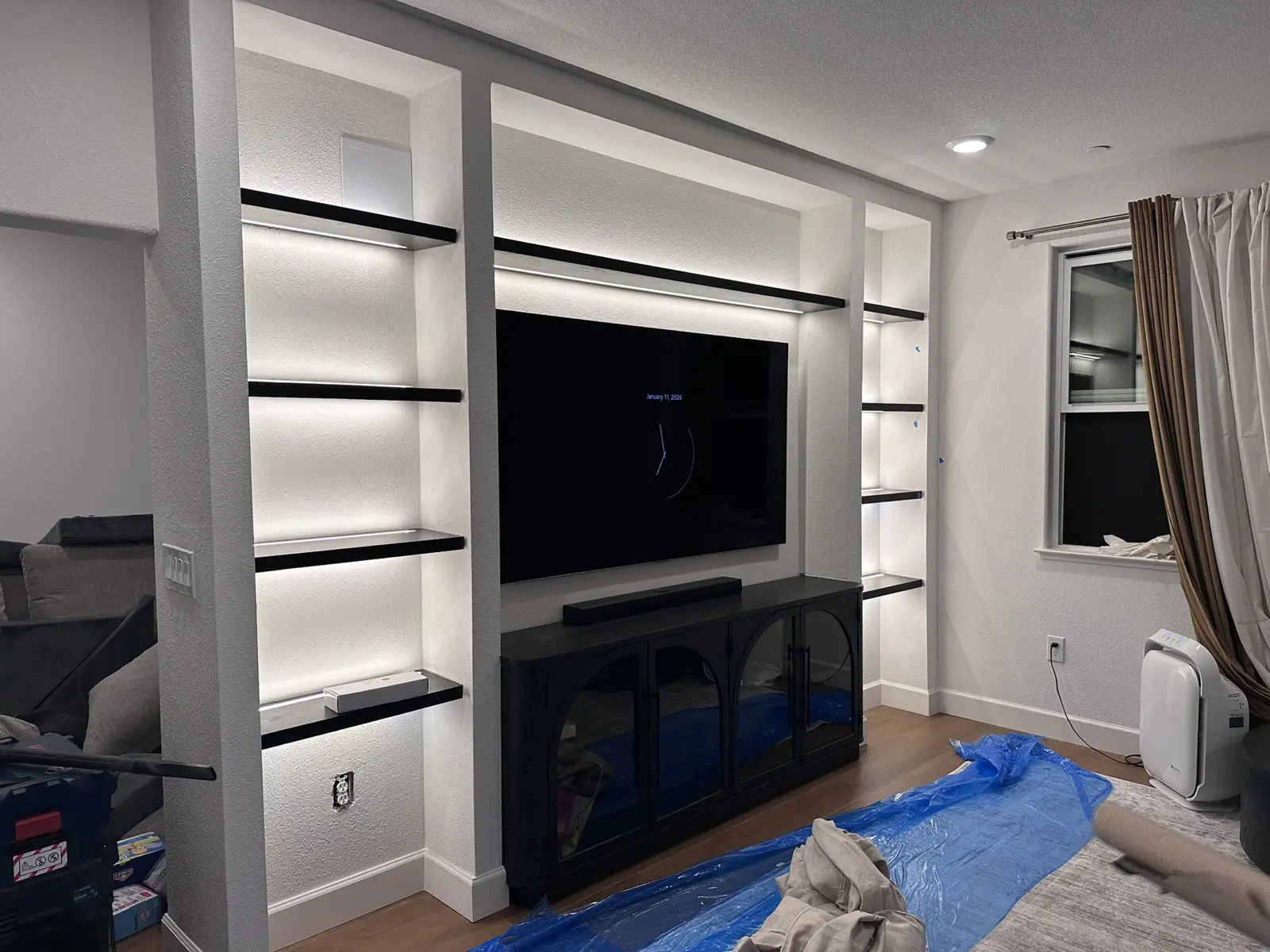
A fixture can look perfect and still be badly supported, badly switched or wired into something questionable. A technically correct installation can still look wrong if the lights were badly placed.
Placement before cutting
Positions for recessed lighting, pendants and island fixtures are agreed before the ceiling is opened.
What is behind the fixture
A damaged box, a loose connection or poor mounting gets dealt with, not covered up.
One electrical scope
Cable, switches, dimmers and any new circuit stay with the fixture. No second trade afterwards.
The scope follows the room
Sometimes one fixture, sometimes several new positions, sometimes better switching and nothing else.
Litel Electric is a California C-10 electrical contractor serving homeowners throughout our 19-community Sacramento-area service area.
Not sure this is the right job?
Tell us what you are seeing — what is tripping, what changed, or what you are planning — and we will tell you what the work actually is before anyone drives out.
Lighting installation questions
Can you add a ceiling light where there is no fixture now?
Usually. What decides it is where the power comes from, how the cable reaches the position, and where you want the switch.
Can recessed lights be added without attic access?
Often. Housings are recessed lighting. Wafers where a can will not fit are canless lighting.
Can you install light fixtures I already bought?
Yes, if they suit the location and the installation. You hear about a problem with one before it goes up, not after.
Can you move an existing light to a different position?
Yes. It means relocating the electrical connection and the support, so the ceiling or wall decides how involved it is.
Can you fix lights that flicker or buzz?
Yes. It can be the fixture, the dimmer, the switch, the wiring or the supply. A dimmer that does not match the load is dimmer installation.
Do you install outdoor and landscape-area lighting?
Coverage at entries, garages, patios, walkways and side yards is exterior and security lighting. Holiday rooflines are a different page.
Who do I call to install a light fixture?
Call us. We hang the fixture, match it to the ceiling support, and connect the switch wires correctly.
Can I install lighting myself?
Swapping a like-for-like fixture on a known ceiling support is the simple case. New recessed lights, new switches, and outdoor wet-location work is our job.
Still not sure it is the right job? Call (279) 972-9272 — available 24 hours.Want the detail? Flickering lights
Helpful guides
Flickering lights
One LED on a dimmer is a different problem from half the house brightening and dimming. Where it happens, and what else changes, tells you where to start.
Read guideHome theater electrical
Plan circuits, projector power, lighting zones, AV equipment, and cable pathways before drywall, cabinetry, and acoustic treatment close the room.
Read guide
Serving 19 communities across the Sacramento area
Litel Electric serves homeowners throughout all 19 communities in our service area — from Davis and Woodland to Roseville, Folsom, and Elk Grove.
Get estimate
Tell us what is happening, or what you are planning. We read the details, tell you what else we need to know, and explain the next step before anything is scheduled.
- 01
You send the problem or the plan, with the address if you have it.
- 02
We reply with what it involves and what has to be seen in person.
- 03
Nothing is scheduled, and nothing is priced, until the equipment has been looked at.
- hi@litelelectric.com
- License
- CSLB #1115460 · C-10 electrical