
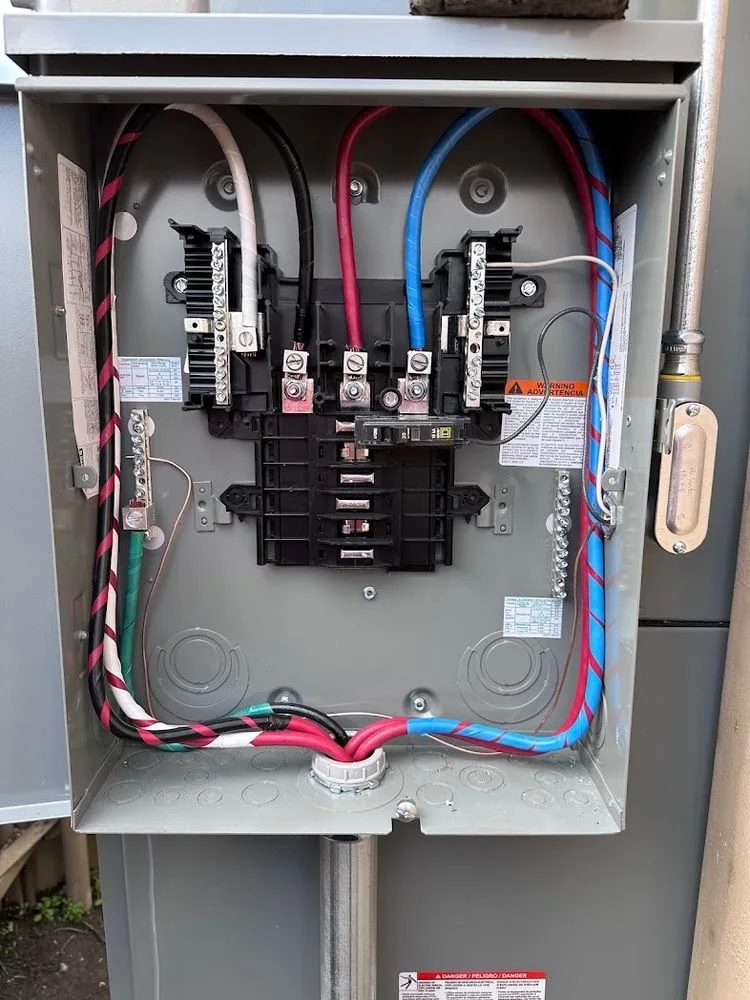
A faint electrical hum and a loud electrical buzz are not the same symptom. Some electrical equipment can make a quiet, steady hum during normal operation, but a new, noticeable, intermittent, crackling, sizzling, or load-dependent sound from the breaker panel deserves attention. A panel that buzzes only when the air conditioner starts points in a different direction from a breaker that buzzes continuously with no large appliance running, and buzzing accompanied by heat, burning odor, flickering lights, or repeated breaker trips should be treated much more seriously.
A faint steady hum can be normal. A new, loud, crackling, or load-dependent buzz is not. If there is heat or a burning smell, stay away from the panel.
Quick answer: should an electrical panel make noise?
A breaker panel should not normally produce a prominent buzzing, crackling, or sizzling sound. A very faint, steady hum may come from certain electrical components and may not indicate a fault by itself. What matters is not simply “is buzzing normal?” It is what kind of sound it is, when it happens, and what changes at the same time.
What is more concerning is a sound that is new, clearly audible from several feet away, getting louder, coming from one breaker, intermittent or irregular, tied to a large electrical load, or crackling, popping, or sizzling rather than humming. Buzzing is a symptom. The pattern tells you how seriously to treat it.
The sound becomes more urgent when it appears together with burning or hot-plastic smell; unusual warmth, discoloration, or scorch marks; flickering or dimming lights, repeated breaker trips, or partial power loss; and visible sparking or smoke.
| Sound / pattern | How to treat it |
|---|---|
| Extremely faint, stable hum that has always been there | Mention at inspection if there are no other symptoms |
| New, clearly audible, or increasing buzz | Arrange prompt diagnosis |
| Buzz from one breaker or under a large load | Test that circuit under the load that produces it |
| Crackling, sizzling, heat, odor, or repeated trips | Treat as urgent |
| Smoke, flame, or active sparking | Leave and call emergency services |
What causes an electrical panel to buzz?
The most common possibilities are a loose electrical connection, a failing circuit breaker, a heavily loaded circuit or breaker, arcing at a damaged or loose connection, a loose or damaged connection to the panel bus, a neutral or service connection problem, or electrical equipment near the panel rather than the panel itself. You cannot reliably identify which one is occurring from sound alone, which is why opening the panel and tightening random connections is not an appropriate diagnostic method.
A loose electrical connection is one of the most important possibilities. A conductor should make a solid, properly terminated electrical connection. If a connection becomes loose, current can encounter increased resistance or intermittent contact, and possible symptoms include buzzing, crackling, heat, intermittent power, flickering lights, discoloration, and burning odor. That can happen at a breaker terminal, the neutral bar, the grounding bar, a splice, a bus connection, or the service equipment. The important issue is not the noise itself — it is that a poor connection can generate concentrated heat at the point of failure.
Why a loose connection can make noise. Alternating current changes direction repeatedly, and electrical and magnetic forces can produce small amounts of mechanical vibration in components. If a connection or component is not secure, that vibration can become audible. More seriously, an incomplete electrical connection can also arc. Arcing can create buzzing, crackling, popping, or sizzling, and those sounds should not be treated as ordinary panel hum. Electrical Safety First specifically identifies buzzing or crackling as a possible sign of electrical arcing and advises that it not be ignored.
A circuit breaker may be failing. A breaker contains both electrical contacts and a trip mechanism. As it ages or becomes damaged, its internal components may no longer behave normally, and possible symptoms include buzzing from one breaker, unusual warmth, repeated tripping, failure to remain set, visible damage, and burning odor. If the sound can be localized to one breaker, that is useful information for the electrician — it does not mean the breaker should simply be replaced without checking the circuit. A breaker can be reacting to a problem downstream, so the electrician still needs to determine whether the cause is the breaker, the connected load, the branch circuit, or the breaker-to-bus connection.
A breaker can buzz without tripping. Circuit breakers are primarily designed to respond to specified overcurrent conditions, and a breaker does not necessarily trip every time something inside or around it is abnormal. A loose connection, damaged contact, vibration, or certain arcing conditions may create heat or noise without immediately producing the type or magnitude of current that causes a standard breaker to trip. That is why “the breaker has never tripped” does not prove that a buzzing breaker is healthy. The sound itself deserves investigation if it is new or pronounced.
Buzzing only when a large appliance runs is an especially useful pattern. If the panel becomes noticeably louder when a specific load operates, note which equipment is running — air conditioner, heat pump, electric range, dryer, water heater, EV charger, hot tub or spa, or workshop equipment. A large load may expose a weak breaker, loose connection, or voltage problem that is less obvious when current is low. For example, quiet panel → EV charger starts → breaker begins buzzing is more diagnostically useful than simply saying the panel makes a noise sometimes. The electrician can reproduce the condition and measure the circuit while the load is operating.
Buzzing under heavy load does not automatically mean the circuit is overloaded. That is a common oversimplification. A sound that appears under load can be associated with an overloaded circuit, but it can also result from a loose connection, a failing breaker, poor breaker-to-bus contact, damaged equipment, or normal vibration becoming more audible at higher current. The actual current should be measured. Replacing or upsizing a breaker without verifying conductor size and circuit design is not an acceptable solution.
Arcing can sound like buzzing, crackling, or sizzling. Arcing occurs when electrical current crosses a gap or poor connection instead of traveling through the intended solid conductive path, and that can generate intense localized heat. Possible sounds include sharp buzzing, crackling, sizzling, or popping — different from a stable, low hum. If the panel is making an irregular crackling or sizzling sound, particularly with heat or burning odor, treat it as a potentially serious electrical fault. Do not remove the panel cover to look for the arc.
Buzzing vs humming vs sizzling
The exact word a homeowner uses is less important than the character of the sound.
A very faint, steady hum may be associated with normal operation of certain electrical components. If it has always been present, is extremely quiet, and there are no other symptoms, it may not represent an immediate fault.
A noticeable steady buzz needs more attention, especially if it is new or comes from one breaker. Possible causes include vibration, breaker problems, or a loose connection.
A buzz that changes with appliance load is a useful diagnostic clue. The circuit, breaker, connections, and load should be checked under operation.
Crackling or popping is more concerning and can indicate intermittent electrical contact or arcing.
Sizzling should be treated as abnormal and potentially urgent, especially when combined with heat, odor, or visible damage.
A faint hum does not always mean the panel is safe. The fact that faint humming can occur normally does not mean every faint hum should automatically be dismissed. Context matters. A low sound deserves more attention if it is new, increasing, localized to one breaker, appearing only under a particular load, accompanied by other symptoms, or following recent electrical work. A sound that has changed is more useful diagnostically than its volume alone.
When the buzzing follows a load or one breaker
Which load is running, whether one breaker is the source, and whether the sound started after recent work are often more useful than the volume alone.
If the panel buzzes when the air conditioner turns on. Large motors draw additional current during startup. A very brief change in electrical sound at the moment an HVAC compressor starts is different from a breaker that continues buzzing loudly while the unit operates. Pay attention to whether the event also causes severe light dimming, repeated breaker trips, prolonged buzzing, difficult compressor starts, burning odor, or panel heat. The fault could be associated with the HVAC equipment, the branch circuit, the breaker, service voltage, or an electrical connection. An electrician may need to coordinate with an HVAC technician if the equipment itself is drawing abnormal current.
If the panel buzzes when the EV charger is running. EV charging is a substantial continuous electrical load. If a breaker or panel connection begins buzzing during charging, do not assume the solution is simply to reduce the charging speed. The installation should be checked for actual charging current, breaker rating, conductor sizing, charger configuration, breaker condition, terminal condition, panel compatibility, and signs of overheating. A properly designed EV charging circuit should be able to carry its intended continuous load without a connection overheating. If the noise began after an EV charger was installed, tell the electrician that timing.
If one breaker is buzzing. If you can identify the source without opening the panel, note the breaker label, what equipment it serves, whether the sound is constant, whether it changes when the load starts, whether the breaker trips, and whether lights on that circuit flicker. Do not press on the breaker, remove it, or take the deadfront off to “see if it is loose.” The useful next step is electrical testing, not mechanical experimentation.
If the main breaker is buzzing. A sound that appears to come from the main breaker deserves prompt evaluation. The main breaker carries the combined load for the home’s electrical system. Possible causes include a breaker problem, a loose service conductor termination, a connection to the bus, high loading, or an upstream service issue. Some components on the service side of the panel can remain energized even when the main breaker is switched off — one reason homeowners should not remove the deadfront to investigate a main-breaker sound.
The noise may actually be coming from somewhere beside the panel. Sounds can transmit through metal enclosures and walls. Possible nearby sources include a transformer, doorbell transformer, contactor, relay, transfer equipment, solar equipment, battery equipment, EV energy-management equipment, or the utility meter or service equipment. An electrician should first confirm the actual source. Replacing a breaker will not solve a transformer humming on the wall beside the panel.
If the buzzing started after electrical work, tell the electrician exactly what was changed — panel replacement, breaker replacement, EV charger installation, HVAC installation, solar installation, battery installation, a kitchen remodel, a new dedicated circuit, or a service upgrade. A new sound after electrical work may point toward a termination, breaker selection, equipment compatibility, a new load, or an altered circuit. The timing can significantly narrow the diagnostic process.
How urgent is electrical panel buzzing?
Buzzing itself is not the hazard. The concern is what may be producing it, and whether heat, odor, flicker, or trips appear with it.
If the panel is warm too, do not use your hand to probe a suspicious electrical panel for heat. But if unusual warmth is already apparent from the exterior, especially together with buzzing, that raises the level of concern. Heat can result from a high-resistance connection, overloaded equipment, a damaged breaker, poor bus contact, or arcing. A pronounced hot spot inside an electrical panel should not be treated as normal simply because the breaker has not tripped.
Buzzing plus a burning smell should be treated urgently. A hot-plastic, insulation, or electrical burning smell can indicate overheating. If buzzing is accompanied by a strong burning odor, stop using affected electrical loads if you can do so safely, stay away from the panel if it appears damaged, hot, sparking, or smoky, and arrange urgent electrical service. If there is active smoke, flame, or fire, leave the building and call emergency services. Do not use water on an electrical fire.
Buzzing plus flickering lights. If panel buzzing occurs together with lights flickering or dimming, note whether one circuit is affected, several rooms are affected, lights change when one appliance starts, or some lights brighten while others dim. This can point toward a circuit connection problem, a neutral problem, a panel connection problem, a service issue, or a utility voltage issue. If some areas become noticeably brighter while others dim, a neutral or service problem is one possibility and should be checked promptly.
Buzzing plus repeated breaker trips. A breaker that repeatedly trips is already telling you the circuit needs diagnosis. Adding buzzing makes repeated resetting even less appropriate. Possible causes include overload, a short circuit, a ground fault, an arc fault, a failing appliance, a failing breaker, or damaged wiring or a connection. Do not keep resetting the breaker until it happens to stay on. The cause needs to be found.
Is a buzzing electrical panel a fire hazard? It can be, depending on the cause. A loose or arcing connection can create enough localized heat to damage insulation, a breaker, a conductor, the panel bus, or surrounding material. Electrical safety organizations identify buzzing, crackling, heat, discoloration, repeated trips, and burning odors as warning signs that should not be ignored. That is why a new pronounced buzz is worth diagnosing before it progresses to visible damage.
When to shut off the main breaker. Do not create additional risk trying to reach a panel that is smoking, sparking, visibly arcing, wet, severely damaged, extremely hot, or surrounded by smoke or fire. Leave the area and call emergency services when there is an active fire or immediate danger. If there is no active fire and the panel can be reached safely, an electrician or emergency service may advise de-energizing the system. But shutting off the main breaker does not make every component inside a service panel safe to touch. Utility-side conductors can remain energized. Do not remove the panel cover afterward.
A practical way to think about urgency: mention at inspection an extremely faint, stable hum that has always been present, with no heat, odor, flicker, or breaker problems, or known equipment that normally produces a mild hum. Arrange prompt diagnosis for new buzzing, clearly audible buzzing, sound from one breaker, buzzing tied to a large appliance, intermittent panel noise, or increasing noise. Treat as urgent crackling or sizzling, a burning smell, unusual heat, scorch marks, repeated breaker trips, substantial flickering, or partial power loss. Leave and call emergency services for smoke, visible flame, active sparking or arcing, or an electrical fire. This is more useful than declaring every panel sound either “normal” or “an emergency.”