
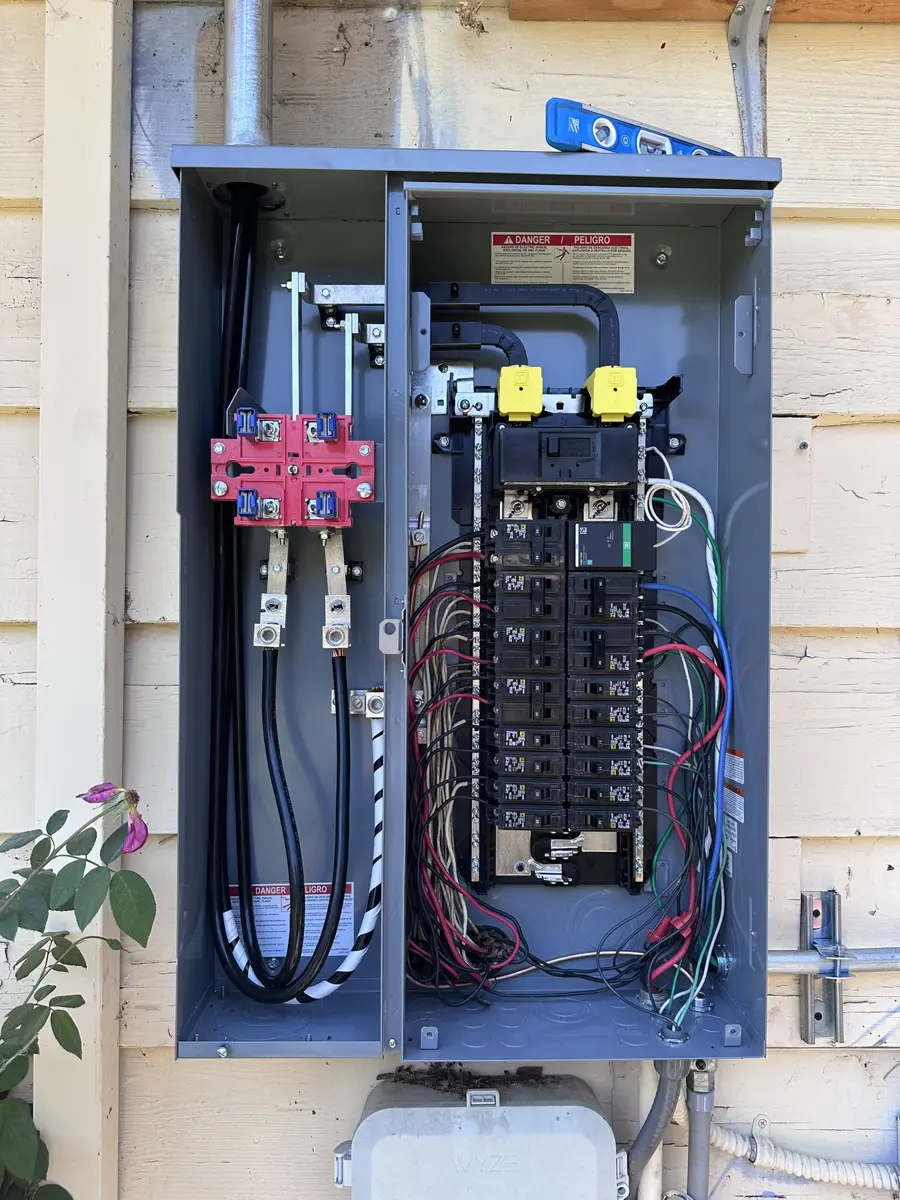
A Federal Pacific panel is electrical equipment made by Federal Pacific Electric — FPE — the Stab-Lok line of breakers and panelboards common in houses built from the 1950s into the 1980s. Two things drive the questions people bring here: independent testing has documented FPE Stab-Lok breakers that fail to trip on an overload far more often than modern breakers, and many insurers and home inspectors now flag the equipment. What follows is how to identify one, what actually fails, why swapping breakers does not fix it, and how a replacement and its permit work in Sacramento. This is a general explainer, not a diagnosis of a specific panel.
Identify it by the nameplate and the breakers, not the age of the house. The documented risk is a breaker that fails to trip; swapping breakers is not the fix, replacement with listed equipment is.
| Situation | What it is | Starting point |
|---|---|---|
| Nameplate says Federal Pacific, FPE, or Stab-Lok | Equipment identification | Photos of the door-open panel, nameplate and breaker faces |
| Breakers that fail to trip on overload | The failure mode behind the reputation | Evaluation of that specific panel, not a brand verdict |
| New or old-stock FPE breakers on the old bus | Not a complete fix | Replacement with listed equipment |
| Listed modern panel in the same location | Panel replacement | Permit, utility disconnect and reconnect, new directory |
| Mast, meter, or grounding has to move | A service change, a different job | Utility at the address: SMUD, Roseville Electric, or PG&E |
| Insurer or inspector flagged the panel | Underwriting or a sale finding | Underwriting is separate from a building-code trigger |
How do you identify a Federal Pacific or Stab-Lok panel?
The label and the breakers settle it, not the age of the house. The nameplate inside the door may read Federal Pacific Electric, Federal Pacific, or FPE; the word Stab-Lok describes the breaker-and-bus design and does not always appear on the panel label even when the equipment is Stab-Lok. FPE Stab-Lok breakers often carry a distinctive center stripe or colored marking on the handle, but handle color alone is not proof — the line changed over the years and breakers get replaced. An inspector’s note or an insurer’s letter is a good reason to look, but the equipment in front of you decides, so the first useful thing you can send is a photo of the panel with the door open, the nameplate and breaker faces especially.
Confirming the design from the inside — the shape of the bus openings the breakers stab into, catalog numbers, the fact that other brands of breaker will not fit an FPE bus — is work for an electrician. Do not remove the deadfront to identify it. The deadfront is the barrier between you and energized parts, and on FPE equipment loose or poorly seated breakers are part of the concern.
Why do Federal Pacific breakers fail to trip?
A breaker has one job during an overload or a short: open the circuit before the wiring overheats. The concern with FPE Stab-Lok is that it does not reliably do that.
Breakers that fail to trip
The U.S. Consumer Product Safety Commission’s own testing in the early 1980s confirmed that some FPE breakers failed certain Underwriters Laboratories calibration tests — the tests that verify a breaker trips within limits when current climbs above its rating. Independent testing since then, most of it by engineer Jesse Aronstein and central to a New Jersey class-action case, has reported FPE Stab-Lok failure-to-trip rates far above those of modern breakers, varying widely by breaker type and test conditions. The exact rate is disputed; that the equipment fails these tests at a meaningful rate is not.
A breaker that tested fine is not cleared
Two things make the failure hard to catch by looking. Aronstein’s work found that once a Stab-Lok breaker has been through an overcurrent event, its chance of failing to trip on the next one can rise — so a breaker that appears to work is not proof of a safe panel. And a Stab-Lok breaker can read OFF at the handle while the circuit downstream stays energized. Because all of this develops inside the panel, an FPE panel can look clean, show no scorch marks, and still carry the risk.
Is there a Federal Pacific recall?
No. There is no formal CPSC recall of Federal Pacific panels or Stab-Lok breakers. That is worth stating plainly, because “recall” is often assumed. The CPSC opened an investigation in 1980 after the manufacturer reported that many breakers did not comply with UL requirements, and its testing confirmed calibration failures — but the agency closed the case in 1983 without ruling either way, saying it would cost several million dollars it did not have to gather the data needed to settle the question. The CPSC specifically cautioned that the closure should not be read as a finding that the equipment is safe. So both things are true at once: there is no recall order, and there is a documented body of test failures. The decision to replace is made on the condition and design of the specific panel, not on a regulator’s list.
Do replacement breakers fix a Federal Pacific panel?
Not as a complete fix. The concern is the Stab-Lok design and the breaker-to-bus connection it depends on, not one aging breaker in isolation, and buying new or old-stock FPE breakers to drop into the same bus leaves that design in place. Replacing an individual breaker can make sense when an electrician is repairing equipment that is otherwise sound and suitable to keep in service. It is a much weaker answer to the real question here — whether an FPE Stab-Lok panel should remain the home’s main distribution equipment. Where the equipment itself is the concern, the durable repair is replacing the panel with a modern listed panel and breakers listed for it, not a breaker-by-breaker substitution on the old bus.
Does every Federal Pacific panel need immediate replacement?
Not automatically, and not on the brand name alone — but an FPE Stab-Lok panel is not equipment to treat as an ordinary modern panel just because it is still delivering power. It is a strong candidate for replacement, and whether yours needs it now depends on the condition of that panel and what the house now asks of it. The case gets stronger when one or more of these is true:
- visible heat damage, discoloration, melting, or arcing
- breakers or connections that are loose, damaged, or will not seat cleanly
- questionable replacement breakers or parts already in the panel
- a panel undersized for the home’s present loads
- an EV charger, HVAC conversion, remodel, ADU, hot tub, or other substantial new load being planned
- a service upgrade already happening for another reason
- an insurer, buyer, lender, or inspector raising the equipment as an issue
Stop using the circuit and call promptly — do not wait for a routine estimate — if the panel shows an active problem: a burning or hot-plastic smell, crackling or arcing sounds, smoke or scorching, a cover that is hot to the touch, breakers that will not stay set, or partial power loss that does not match a utility outage. If there is smoke or fire, leave and call emergency services. Do not remove the cover, tighten terminals, or test a breaker by forcing an overload.