
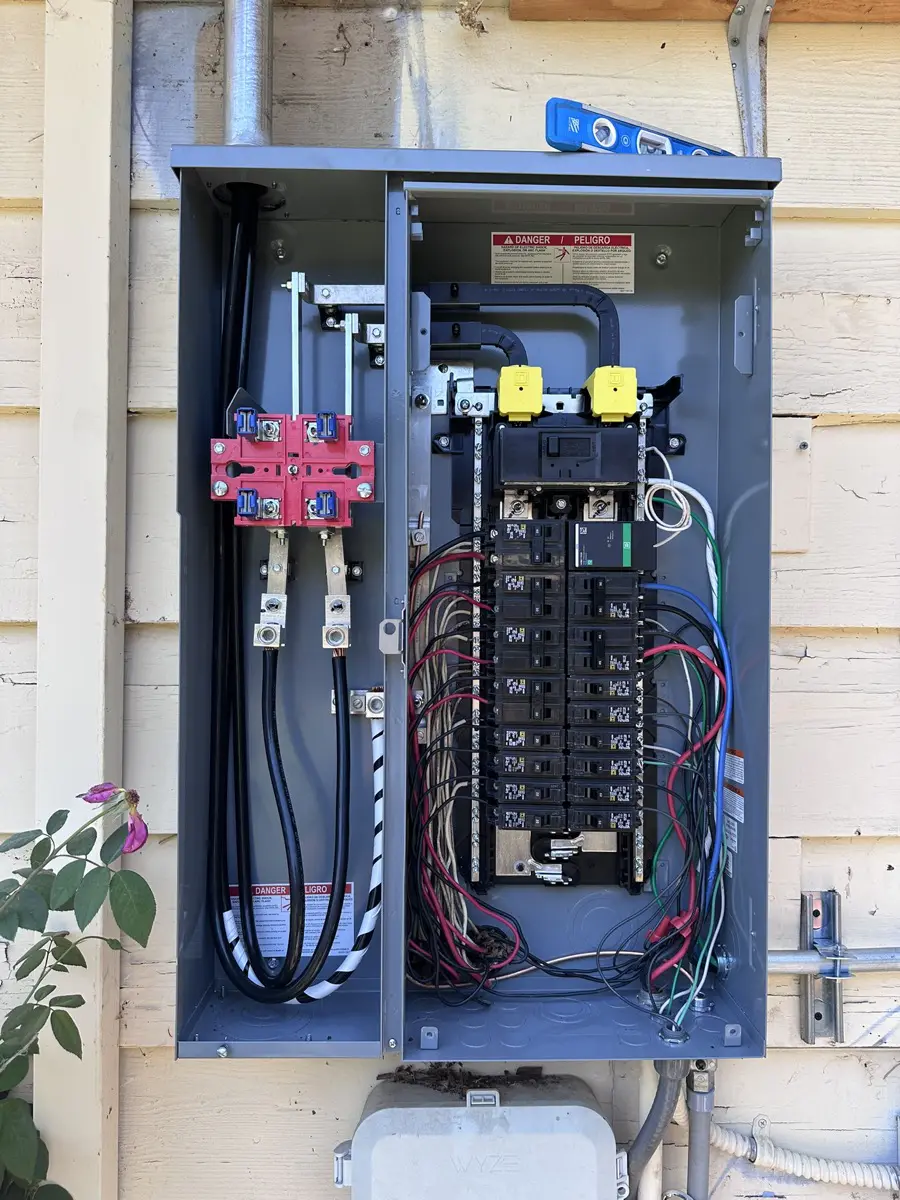
You walk into the garage in the morning, the car has barely charged, and the breaker for the charger is off, or the GFCI on its outlet has popped. Resetting it may work for a night or two. A breaker that keeps tripping on a charger is telling you something, and the fix depends on whether the cause is the car, the charger or the circuit in the house.
Why does your EV charger keep tripping the breaker?
A charger pulls a steady, heavy load for hours. Anything weak in the circuit shows up under that load: a connection that heats up, a breaker that is tired, a circuit that is shared with something else, or two protective devices that do not agree. The usual causes are:
- Another load on the same circuit. A freezer, a shop tool or a garage heater on the charger’s circuit pushes the total over what the breaker allows
- A GFCI in front of a charger that has its own ground-fault protection. More on that below
- Heat at a connection. A loose or worn plug, outlet or breaker connection heats under continuous current until the breaker trips, or until something melts
- Heat in the garage. A charger on an unshaded west-facing wall can overheat on a summer afternoon and shut down or trip, then work fine at night
- A fault in the charger, the cable or the car.
Most of these do not show up in a quick test with nothing plugged in. They show up after an hour of charging.
Is it the charger, the car, or the house wiring?
You can narrow it down without touching the panel. If you can, plug the car into a different charger, at a friend’s house or a Level 2 station, for a full session. If the car charges fine elsewhere but not at home, the problem is at your house: the charger or the circuit. If a second car charges fine on your charger, the problem is likely your car or its charge port.
A public fast charger does not settle it. Fast chargers feed the battery a different way from a home charger, so a car that fast-charges fine on the road can still have a problem with home charging.
Write down when it trips: right when charging starts, an hour in, only on hot afternoons, or only when the dryer or the air conditioning is running. That pattern is the most useful thing you can tell whoever looks at it.
Why does a GFCI trip with a plug-in charger?
Because the charger already has its own ground-fault protection. Listed Level 2 chargers have a built-in device that cuts power if current leaks where it should not. It trips at a higher level of leakage than a GFCI breaker or outlet does.
When a GFCI sits in front of the charger, you have two ground-fault devices in a row set to different levels. Small, normal leakage while charging can trip the GFCI even though the charger sees nothing wrong. The electrical code requires GFCI protection on a 240-volt garage outlet and on any outlet installed for EV charging, so a plug-in charger will have one. Adding a GFCI outlet in front of a charger because you thought it would be safer can start this problem.
When the outlet GFCI is the cause, the usual fix is to hardwire the charger. With no outlet, the outlet GFCI rule no longer applies, and the charger’s own protection does the job. The hardwired or plug-in guide explains that choice.