
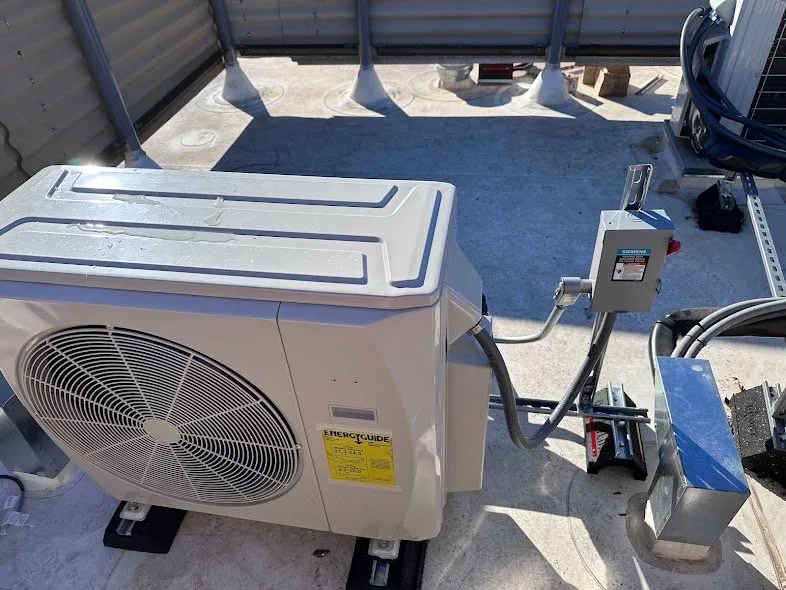
A heat pump or mini-split does not have one universal circuit size. You cannot reliably say “A 12,000 BTU mini-split needs a 20A breaker” or “A 3-ton heat pump needs a 40A circuit.” The correct electrical circuit comes from the actual equipment nameplate and installation instructions.
For most residential heat pumps and mini-splits, the key values are supply voltage, phase, MCA — Minimum Circuit Ampacity, MOCP / MOP — Maximum Overcurrent Protection, the required disconnect, the indoor-unit power arrangement, and auxiliary heat if any. Those values determine conductor sizing, breaker or fuse size, disconnect rating, whether one or multiple circuits are required, whether the panel has enough capacity, and whether a service upgrade is actually necessary. For Sacramento homeowners, the electrical plan should be checked before the HVAC equipment is ordered or installed.
nameplate → MCA → MOCP → disconnect → panel → permit
Heat-pump and mini-split electrical requirements at a glance
| Requirement | What to verify |
|---|---|
| Nameplate | MCA and MOCP/MOP from the outdoor unit — not BTU or tonnage |
| Voltage | 120V/115V or 208/230V single-phase, as listed |
| Circuit | Dedicated branch circuit for the outdoor unit |
| Breaker | Must not exceed listed MOCP; common residential values range from 15A to 40A or more |
| Wire | Size from MCA, then conductor rules — not from breaker size alone |
| Disconnect | Accessible disconnecting means near the outdoor equipment |
| Indoor heads | Often powered from the outdoor unit; check the matched-system diagram |
| Auxiliary heat | Central heat kits can add separate high-amperage circuits |
| Panel upgrade | Not automatic |
| Permit | City lists residential HVAC for one- and two-family dwellings as minor-permit work; new circuits are also permit work |
Most residential mini-split outdoor units use a dedicated circuit. Common systems may use 120V single-phase, 208/230V single-phase, 15A, 20A, 25A, 30A, or larger overcurrent protection depending on the equipment — but these are examples, not sizing rules.
A current 24,000 BTU Daikin mini-split condenser, for example, has been documented with 208/230V single-phase supply, MCA around 16A, and maximum overcurrent protection of 20A. Another 24,000 BTU system from a different manufacturer can have different values. BTU rating does not determine breaker size by itself. Read the equipment label.
What circuit does a central heat pump need?
A conventional ducted heat-pump system may have more than one electrical load. The outdoor heat-pump unit contains the compressor, condenser fan, and inverter electronics on variable-speed systems. The indoor air handler contains the blower motor and controls. Electric auxiliary / emergency heat may contain resistance heating elements. Those loads may require one circuit for the outdoor unit, another circuit for the indoor air handler, and one or more additional high-amperage circuits for electric heat strips — which is why a central heat pump can have a much larger electrical footprint than a ductless mini-split.
A mini-split and a central heat pump are not the same electrical project. A mini-split system often has one outdoor condenser, one or more indoor heads, power supplied to the outdoor unit, and interconnect wiring from outdoor unit to indoor units. A central heat pump may have an outdoor condenser, indoor air handler, separate electric resistance heat kit, thermostat/control wiring, and multiple branch circuits. Do not use a mini-split wiring diagram to plan a central heat pump.
Replacing a conventional AC with a heat pump can change electrical load, indoor equipment, backup heat, and breaker requirements. Do not assume the existing AC circuit automatically matches the new heat pump. Compare the old unit MCA/MOCP, the new unit MCA/MOCP, indoor-unit electrical requirements, and auxiliary heat. The existing circuit may be reusable, or it may need modification.
Start with the nameplate, not the tonnage
HVAC nameplates commonly show voltage, phase, MCA, and MOCP or MOP. Those are more useful for circuit planning than BTU, tonnage, SEER rating, or physical size. Two nominally 2-ton heat pumps can use different compressors, inverter technology, fan motors, and electrical designs. The nameplate controls the branch-circuit design.
MCA means Minimum Circuit Ampacity. It tells the installer the minimum ampacity the supply conductors must provide for the equipment under the applicable HVAC motor/compressor rules. Manufacturer documentation commonly states directly that wire sizing is based on MCA. That is important because HVAC conductor sizing does not always follow the simplified household rule that breaker size equals wire ampacity. For motor-compressor equipment, the electrical code permits a different relationship between conductor ampacity and overcurrent protection.
MOCP means Maximum Overcurrent Protection, or manufacturers may use MOP — Maximum Overcurrent Protection Device. This is the largest fuse or circuit-breaker rating the manufacturer permits for the equipment. For example, MCA = 18A and MOCP = 30A does not automatically mean something is wrong. The conductors are selected to satisfy the equipment’s MCA and applicable wiring rules. The breaker or fuse is allowed to be larger than the conductor’s ordinary general-purpose branch-circuit relationship because compressor circuits have special motor-starting and overload characteristics. That is normal HVAC electrical design when done according to the equipment label and code.
Why can the breaker be larger than you expect from the wire? A compressor can draw significantly more current during certain operating or starting conditions than during normal running. If an ordinary breaker were sized only to normal running current, it could trip unnecessarily during legitimate operation. HVAC motor-compressor rules therefore separate conductor protection — the conductor is sized from MCA — from short-circuit and ground-fault protection, where the breaker or fuse is selected within the equipment’s allowed MOCP/MOP. The equipment itself also contains or relies on motor overload protection. This is one reason not to size mini-split wiring from generic breaker/wire tables.
Example: MCA 16.2A, MOCP 20A. Suppose the outdoor unit says 208/230V, MCA 16.2A, MOCP 20A. The electrician designs the circuit so that conductor ampacity meets or exceeds 16.2A under the applicable conditions, the breaker or fuse does not exceed 20A, and the equipment and disconnect are rated appropriately. That is much more precise than saying “It’s a 24K mini-split, so use 20A.” Another 24K unit might have different MCA/MOCP values.
Example: MCA 26A, MOCP 40A. Some equipment can have a larger spread. That does not automatically mean the circuit is undersized. The HVAC rules account for compressor operation, motor starting, and overload protection. The nameplate values exist specifically so the field wiring can be designed correctly.
How to read the nameplate. Look for voltage (examples: 115V, 208/230V), phase (most residential systems are single phase), MCA (minimum conductor ampacity), MOCP / MOP (maximum breaker or fuse rating), compressor RLA (rated load amps), and fan FLA (full load amps). You usually do not need to independently calculate the compressor circuit from RLA if the manufacturer has already provided MCA and MOCP. Use the nameplate values.
In practice, the plan for a residential mini-split is a 240V double-pole branch circuit with conductors meeting the unit’s MCA, an overcurrent device no larger than its MOCP, equipment grounding, a local disconnect, and the manufacturer’s outdoor-to-indoor wiring — designed from the nameplate, not from the BTU rating.
A practical central-heat-pump example: outdoor unit MCA 24A, MOCP 40A; air handler with a small blower circuit; 10 kW heat kit on a separate high-amperage circuit. The home may therefore need several breakers, and the service calculation must include the system as designed. This is why central heat-pump electrical planning should happen before the equipment package is finalized.
Dedicated circuit, indoor heads, and 120V vs 240V
Usually, yes — the outdoor unit is normally supplied by an individual branch circuit designed for that equipment. Do not share the mini-split circuit casually with receptacles, lighting, garage loads, or another unrelated appliance. The actual manufacturer instructions should confirm the power-supply arrangement.
Does each indoor mini-split head need its own circuit? Usually not on many common systems. In many ductless systems the branch circuit feeds the outdoor unit, and the outdoor unit then supplies or control-connects the indoor head or heads. Some system designs differ, including certain multi-zone systems, separate indoor-unit power arrangements, accessory heaters, condensate pumps, and controls. Check the complete matched-system wiring diagram. Do not assume every indoor head should receive a separate 120V circuit.
Single-zone vs multi-zone. A single-zone system has one outdoor unit serving one indoor unit, and electrical planning is usually straightforward. A multi-zone outdoor unit can serve two, three, four, or more indoor units, and may have larger MCA, larger MOCP, and more complex interconnect wiring. The circuit should be sized from the actual multi-zone condenser nameplate, not by adding the amperage of the wall heads independently.
Mini-splits are available in both voltage classes. 120V / 115V systems are common on smaller-capacity equipment and typically use a hot, a neutral, an equipment ground, and a single-pole breaker. 208/230V or 240V systems are very common on larger systems and typically use two hot conductors, an equipment ground, and a double-pole breaker. Many 240V mini-splits do not require a neutral, but the exact wiring diagram controls. Do not install a neutral simply because another 240V appliance uses one.
Does a 240V mini-split need a neutral? Often, no. Many 208/230V mini-split condensers use L1, L2, and equipment ground. The indoor unit is powered through the manufacturer-specified interconnect wiring. Some equipment configurations can differ, so check the diagram. Do not assume 240V = two hots + neutral + ground for every HVAC system. Smaller systems can be 120V; do not assume every mini-split is 240V.