
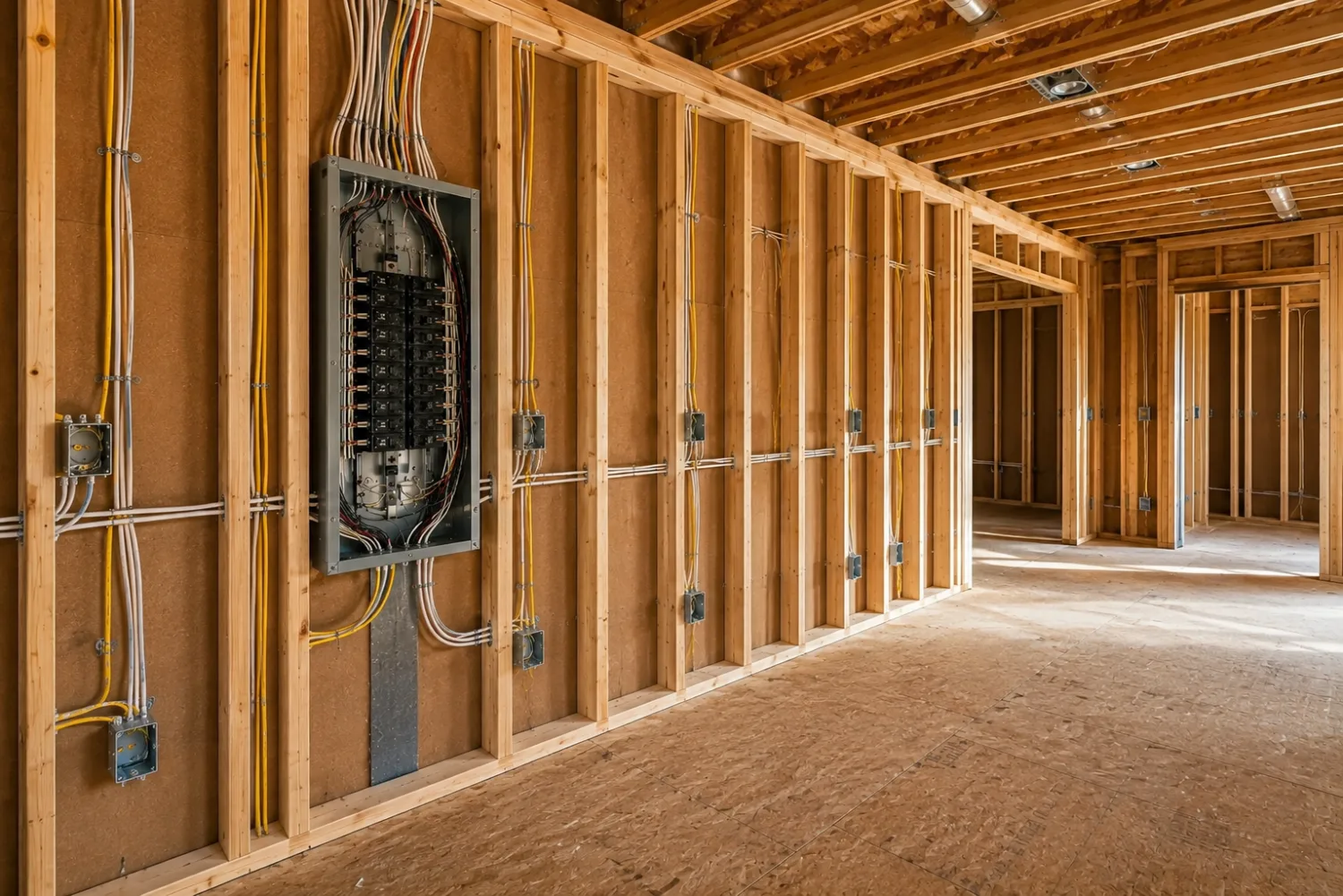
A house does not need rewiring simply because it is old. One flickering light, one dead outlet, or one tripped breaker does not automatically mean the wiring in the walls has failed. The 10-second answer is:
Patterns decide the scope — one device, one circuit, one part of the house, or the wiring system as a whole.
That distinction is what separates a $200 repair from a partial or whole-house rewire.
Rewire vs repair: what actually decides the scope
| Scope | When it fits |
|---|---|
| One-device repair | One receptacle, switch, fixture, or loose connection |
| One-circuit replacement | One damaged, overloaded, or poorly routed branch circuit |
| Partial rewire | One floor, one wing, one addition, or selected old circuits |
| Whole-house rewire | Most circuits share the same obsolete or deteriorated condition |
The stronger signs are patterns: several circuits showing problems; widespread ungrounded wiring; brittle or damaged insulation; old wiring systems that have been heavily altered; repeated overheating or loose connections; too few circuits for the way the house is now used; and evidence that decades of additions and repairs have left the electrical system difficult to verify.
A rewiring inspection becomes more important when you have several of these conditions:
- frequent breaker trips on otherwise normal loads
- flickering or dimming across more than one room
- burning or hot-plastic smells near outlets or switches
- warm, discolored, or scorched receptacles
- buzzing or crackling from wiring devices
- widespread two-prong or ungrounded outlets
- damaged, brittle, or crumbling wire insulation
- active knob-and-tube wiring
- older solid aluminum branch-circuit wiring
- repeated dead outlets or intermittent circuits
- heavy reliance on extension cords because there are too few receptacles
- obvious DIY alterations or open splices
- a major remodel exposing wiring that is already obsolete or deteriorated
None of these, by itself, proves that the entire house needs to be rewired. They are reasons to inspect the system and determine the actual scope.
Breakers, flickering lights, heat, and burning smells
A single breaker, fixture, or receptacle can fail on its own. These symptoms become stronger rewiring evidence when they show up in more than one place.
Breakers keep tripping during normal use. A circuit breaker trips to protect the circuit. One trip can be caused by too many appliances on one circuit, a faulty appliance, a temporary overload, a short circuit, a ground fault, or an arc fault. What matters is repetition. If the same breaker trips again and again during ordinary use, the circuit needs diagnosis. Possible causes include overloaded circuit design, damaged wiring, a loose connection, a failing breaker, a faulty appliance, or too many rooms or loads sharing one old branch circuit. One overloaded kitchen circuit does not mean the house needs a full rewire. But if many rooms are still depending on a small number of old circuits and normal household loads repeatedly exceed what those circuits can support, broader rewiring may make sense.
Lights flicker in several parts of the house. A single LED lamp can flicker because of a bad bulb, a failing LED driver, an incompatible dimmer, or a loose fixture connection — that is usually not a rewiring problem. The concern increases when several lights flicker together, different rooms are affected, lights repeatedly dim when ordinary appliances run, some circuits lose power intermittently, or flickering appears with buzzing, heat, or burning odor. Those symptoms can point toward branch-circuit connection problems, neutral problems, panel issues, service problems, or damaged wiring. The correct diagnosis may still be one loose connection. But widespread recurring flicker is a reason to look beyond the fixture.
Outlets or switches feel unusually warm. Electrical devices should not normally become hot enough to concern you. Some electronic controls and dimmers can operate somewhat warmer than a basic switch, but warning signs include a receptacle faceplate noticeably hot to the touch, discoloration, melting, a burning smell, crackling, or plugs that fit loosely. ESFI lists overheating, hot or discolored receptacle covers, and unusual electrical sounds among warning signs of home-wiring hazards. The cause may be local — a worn receptacle, a loose terminal, a damaged switch. But if overheating is found repeatedly throughout an older wiring system, replacing devices one at a time may not address the larger problem.
You smell burning or hot insulation. A burning or hot-plastic smell near an outlet, switch, junction box, wall, or electrical panel should be treated as an electrical warning until the source is identified. Possible causes include a loose connection, arcing, an overheated conductor, a damaged device, a failing breaker, or a failing appliance. If the smell occurs with smoke, visible arcing, fire, or rapidly increasing heat, leave the area and call emergency services. If there is no active fire, stop using the affected circuit and arrange prompt electrical diagnosis. One burned receptacle may need one repair. Repeated signs of overheating across multiple circuits are much stronger evidence that broader wiring replacement should be considered.
Two-prong outlets, old wiring, and aluminum
Older wiring methods are clues, not automatic verdicts. Insulation condition, grounding, and connections decide whether a circuit can stay.
Most of the house still has two-prong outlets. Two-prong receptacles often indicate older two-wire branch circuits without a conventional equipment grounding conductor. That does not automatically make every circuit defective. But widespread ungrounded wiring can become a significant limitation for a modern home that now needs to support computers, office equipment, entertainment systems, appliances with three-prong plugs, surge protection, workshop tools, and modern electronics. A GFCI-protected replacement can sometimes be used on an ungrounded circuit under appropriate code provisions. But GFCI protection does not create an equipment grounding conductor. If the goal is a genuinely modern grounded electrical system throughout the house, running new wiring may be the better long-term solution.
The outlets have three prongs, but the wiring is still ungrounded. A three-prong receptacle is not proof that a ground exists. Older homes are sometimes found with grounding-type receptacles installed on older two-wire circuits. Possible situations include a properly grounded receptacle; a GFCI-protected but intentionally ungrounded receptacle; an improperly installed three-prong receptacle with no ground; a wiring method that grounds through approved metal raceway or cable; or an improper neutral-to-ground “bootleg” connection. If many receptacles look modern but test ungrounded, the wiring should be mapped before deciding what to replace. This is exactly the type of house where rewiring decisions should come from inspection rather than visual age.
The wire insulation is brittle or crumbling. The conductor itself may remain electrically conductive while the insulation around it deteriorates. Older insulation can become brittle, cracked, dry, heat-damaged, or mechanically damaged. This can become especially obvious when an electrician opens light fixture boxes, switch boxes, receptacle boxes, attic junctions, or panel terminations. If moving a conductor causes the insulation to crack or fall away, extending that circuit safely becomes difficult. One deteriorated section can sometimes be repaired. Widespread insulation failure is a stronger case for replacing the affected circuits.
You have cloth-covered wiring. “Cloth wiring” is not one precise electrical system. Older cables may have a woven outer covering with different conductor insulation systems underneath, so cloth on the outside does not automatically mean unsafe, knob-and-tube, ungrounded, or a mandatory rewire. The real questions are what cable type is present, whether it has an equipment ground, what condition the conductor insulation is in, whether the cable has been altered, and whether it is still suitable for the loads it serves. Cloth-covered wiring that is intact and properly installed is a different condition from cable whose insulation crumbles when touched.
Active knob-and-tube wiring is still present. Knob-and-tube wiring is an older wiring method found in some older homes. Typical characteristics include individual conductors, porcelain knobs and tubes, no equipment grounding conductor, and different installation assumptions from modern cable systems. The largest practical concern is often not simply the original wiring method — it is what happened to it over decades. Older knob-and-tube systems may have improper extensions, concealed splices, altered connections, insulation placed around wiring, or additional modern loads added later. If a substantial portion of a house still uses active knob-and-tube wiring, especially during a remodel or insulation project, replacement often becomes the cleaner long-term choice.
Older solid aluminum branch-circuit wiring is present. Some homes built or altered during the 1960s and 1970s used solid aluminum conductors on 15A and 20A branch circuits. This is different from larger aluminum conductors still commonly used today for feeders and service conductors. The concern with older aluminum branch wiring is largely at the connections. CPSC has published specific guidance about the increased hazard associated with some older aluminum branch-circuit connections and recognizes permanent repair methods. Possible warning signs include hot switch or receptacle covers, flickering, burning odor, intermittent circuits, and visible overheating. The absence of symptoms does not prove every connection is sound. Possible solutions include approved repair methods or copper replacement, depending on the system and project. A full rewire is not the only possible answer.
Dead outlets, extension cords, and repeated alterations
Repeated failures and a house that no longer matches how it is used often matter more than any one old cable.
Dead outlets keep appearing in different rooms. One dead outlet may be a tripped GFCI, a failed receptacle, a switched outlet, or a loose upstream connection. Repeated failures on different circuits suggest something broader. Look for patterns such as outlets that die intermittently, circuits that return after being disturbed, multiple failed upstream receptacles, recurring loose splices, or repeated heat damage. At some point, continued spot repair becomes less attractive than replacing the affected branch circuits. A wiring system should not become an endless sequence of unrelated failures.
You hear buzzing, crackling, or sizzling. Electrical wiring should not routinely crackle or sizzle. Possible causes include a loose connection, a failing switch, a damaged receptacle, a breaker problem, or arcing. A faint stable hum from some electrical equipment is different. The more concerning sounds are new, intermittent, localized, crackling, or sizzling, or associated with heat or smell. ESFI includes unusual buzzing and sizzling among home-wiring warning signs. If the sound comes with burning odor or visible damage, stop using the affected circuit and have it inspected promptly.
The house has far too few outlets. Older homes were designed before modern households accumulated computers, TVs, chargers, kitchen appliances, home-office equipment, window AC units, portable heaters, and entertainment systems. Too few receptacles often leads to extension cords, multi-plug adapters, power strips, and loads concentrated on a few circuits. A shortage of outlets by itself does not mean the wiring is bad. But if the same house also has old ungrounded circuits, limited breaker capacity, repeated overloads, and dated wiring, rewiring selected rooms may be a much better modernization strategy than adding isolated outlets onto already overused circuits.
Extension cords have become part of the permanent layout. An extension cord is temporary wiring. If extension cords are routinely used to power bedrooms, a home office, entertainment equipment, kitchen appliances, garage tools, or heaters, the permanent wiring may no longer match how the house is used. Sometimes the answer is simply to add more receptacles. But if the underlying circuits are old, ungrounded, and heavily loaded, adding more receptacles without adding circuit capacity can make the layout more convenient without fixing the actual limitation.
The electrical system has been remodeled repeatedly. A house can begin with a coherent electrical system and become difficult to understand after decades of alterations — room additions, garage conversions, enclosed patios, kitchen remodels, bathroom remodels, added HVAC, new appliances, homeowner electrical work, multiple panel changes. The result may include mixed wiring types, hidden splices, abandoned circuits, overloaded original circuits, unclear circuit paths, and old wiring feeding new additions. In these homes, rewiring may be justified not because one original wiring method is inherently unsafe, but because the accumulated alterations have made the system unreliable or difficult to verify.
You find open or improper splices. Electrical splices belong in appropriate enclosures and must remain accessible where required. Warning signs include taped wire joints outside boxes, open junction boxes, buried splices, loose connectors, exposed conductor, overcrowded boxes, and obvious improvised connections. One bad splice can be corrected. Finding dozens of questionable splices throughout an attic, crawlspace, or remodel is evidence that the installation deserves a broader review.
A new panel, a fuse box, shocks, and remodel access
The panel and the branch wiring are different parts of the system. A remodel is often the practical time to decide which circuits should be replaced.
The panel is new, but the wiring is old. A modern electrical panel does not automatically mean the house has modern branch wiring. It is common to find a new 200A service and a modern breaker panel feeding old two-wire bedroom circuits, older cloth-covered cable, or original lighting wiring. A panel replacement changes the distribution equipment. It does not replace the conductors inside the walls. This is why “the panel was upgraded ten years ago” does not answer whether the house needs rewiring.
The house has a fuse box. A fuse box is evidence of an older electrical distribution system, but it does not automatically prove that every branch circuit needs replacement. An electrician should determine conductor sizes, fuse ratings, wiring type, grounding, circuit condition, and whether fuses have been improperly oversized. ESFI specifically warns about electrical panels with protective devices rated above the capacity of the branch circuits. A fuse panel may justify a panel upgrade. A full rewire should still depend on the branch wiring itself.
You get a shock or tingling sensation from appliances. Any unexpected electrical shock deserves investigation. Possible causes include an equipment fault, a missing or failed ground, a wiring error, a neutral problem, a damaged appliance, or leakage current. ESFI includes electrical shocks — even mild tingling — among signs of possible wiring danger. Do not repeatedly touch the equipment to verify the sensation. Stop using the affected appliance or circuit until the cause is identified. If shocks occur at multiple grounded appliances, the investigation should expand beyond one device.
A remodel is about to open the walls anyway. This is often the best time to make a rewiring decision. Access is a large part of the cost and disruption of rewiring. If walls and ceilings are already open for a kitchen remodel, bathroom remodel, addition, insulation project, or major renovation, it may make sense to replace older branch wiring now rather than reopen finished surfaces later. The City of Sacramento currently treats residential rewire work as permitted electrical work under its minor-permit system, and whole-house rewiring generally does not require conventional plan review for a residential minor permit. The permit may be straightforward. The access opportunity may be even more valuable.