
On this page 5 sections
What a whole-home rewire involves
A rewire touches everything: the service, the panel, every circuit and device, and the walls and ceilings in between. It is disruptive enough that it is worth planning as one job rather than discovering it room by room. A rewire in Sacramento is permitted through the city; in Fair Oaks or Carmichael it goes to Sacramento County instead.
Layers of undocumented work
Additions and past changes nobody has a record of turn a piecemeal repair into a guess. A rewire replaces the guesswork with a known system.
Faults across several circuits
When problems show up around the house rather than at one spot, the wiring itself is usually the question, not a single circuit.
A remodel opening the walls
While the walls are already open is the cheapest time to rewire — most of the disruptive part is paid for once.
Wiring that will not carry a repair
Where the existing wiring cannot safely be built on, a dependable fix means replacing it rather than patching it.
Whole-home rewire: plan the electrical work around access and room use.
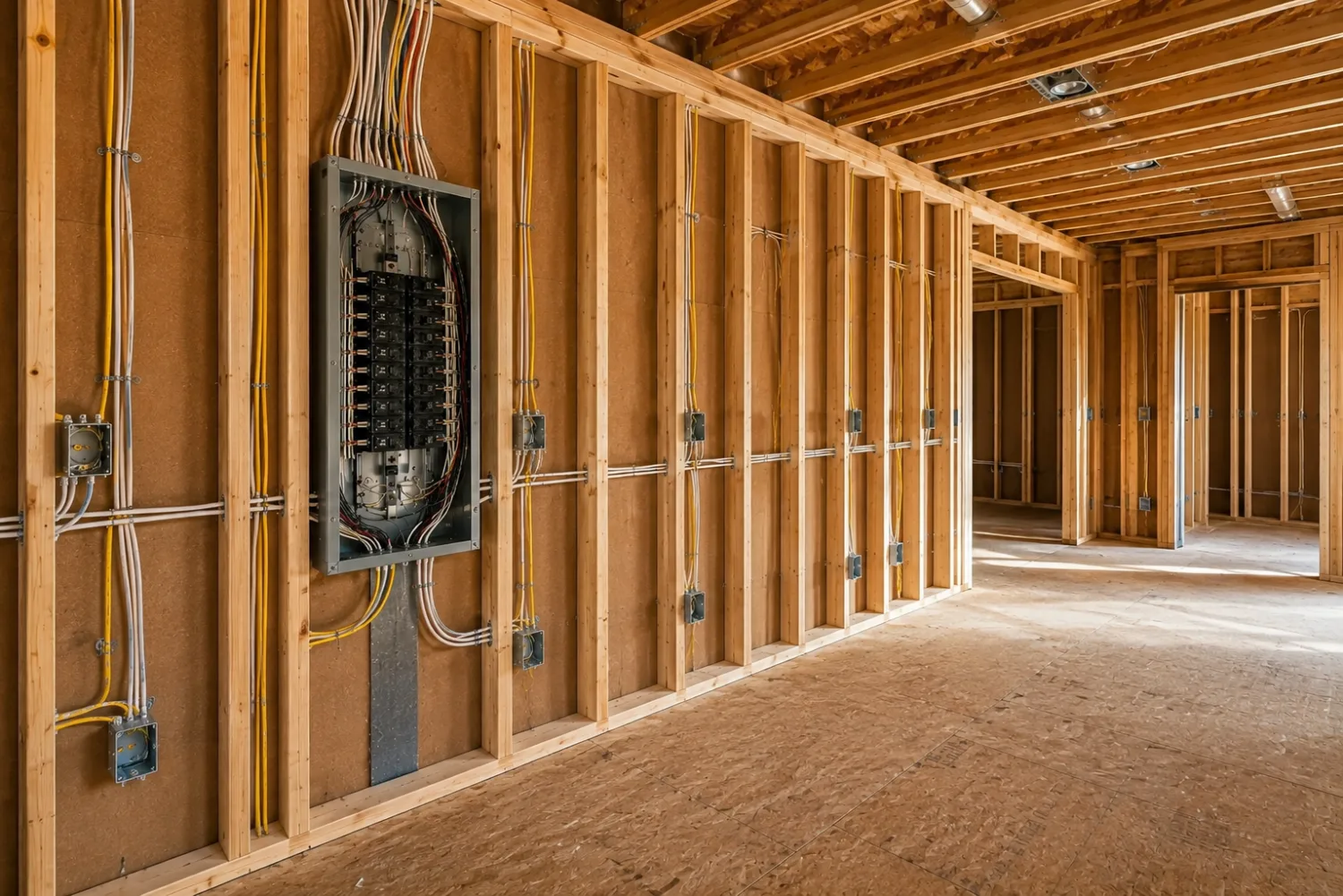
A whole-home rewire is a routing and sequencing project as much as an electrical one. The useful plan connects the condition of existing wiring with how each room will be used and where cables can travel with controlled finish impact.
-
Confirm the true extent
Age alone does not define the scope. Representative wiring condition, previous alterations, recurring symptoms, panel condition, and remodel plans help distinguish a focused repair from work that reaches multiple circuits or rooms.
-
Map practical pathways
Attic, crawl-space, basement, cabinet, and open-wall access can reduce unnecessary finish disturbance. Areas with limited access should be identified early so the proposal can state where openings may be needed.
-
Sequence with other trades
Framing, drywall, cabinets, insulation, and finish work affect when wiring can be reached. Coordinating the circuit plan before surfaces close avoids treating room use and device locations as afterthoughts.
What a rewire covers
What the existing wiring is, and how much of it we can reach
Room by room: outlets, switches, and what gets used where
Whether the panel and service suit the new circuit plan
The order of work, how far into the finishes it goes, and the permit
Whole-home rewire: what helps before we start
List planned room uses and major equipment
Gather remodel drawings if available
Identify areas where access or finish preservation matters most
Flag any room you would rather we did not open up
Whole-home rewire: what changes the cost
A rewire is priced from its extent and its access, not from how old the house is. These are what move it.
-
How much actually gets rewired
A rewire is rarely all-or-nothing. What the existing wiring is, and how much of it can stay, sets the real extent before anything else.
-
Access to run cable
Attics, crawl spaces and basements let cable travel with little finish damage. A slab house with finished walls above and below means opening more to reach the same circuits.
-
Finish disturbance and repair
How much wall and ceiling has to be opened, and who closes it back up, is often a larger share of a rewire than the wiring itself.
-
Run with a remodel, or standalone
Coordinated with a remodel while the walls are already open, most of the disruptive part is paid for once. Standalone, the opening and patching belong to this job.
-
Panel and service
Whether the existing panel and service suit the new circuit plan, or have to change with it, is part of the scope.
Not sure this is the right job?
Tell us what you are seeing — what is tripping, what changed, or what you are planning — and we will tell you what the work actually is before anyone drives out.
Rewiring questions, answered
Does an older property always need a full rewire?
No. Plenty of older wiring is fine. What matters is its condition, what has been altered over the years, and whether it can carry what the house now uses. Cloth or knob-and-tube that can no longer stay is old wiring replacement.
Can rewiring be coordinated with remodeling?
Yes, and it is much cheaper that way. The walls are already open, so most of the disruptive part is paid for once.
Will walls need to be opened?
Some, yes. How much depends on how the house is built and how the cables can be routed — attics and crawl spaces save a lot of wall.
One run was damaged. Is that a rewire?
Usually not. A bounded failed run is electrical wiring repair. Water, fire, or pest damage on a section is damaged wiring repair. This job is when the wiring throughout is the problem.
What are signs my house needs rewiring?
Two-prong outlets, cloth or knob-and-tube in the attic, warm switches, and two wires on one lug in the panel are the usual clues. We look at the wiring, not the year on the house.
Is it worth rewiring your house?
It is worth it when the metal, the grounding, or the condition of the circuits will not support the work you need. We map rooms and tell you what can wait.
Can you rewire a house without removing walls?
Some cables can be pulled through attics, crawlspaces, and existing outlet boxes. Finished walls still get openings where the path is blocked. We plan access before we cut.
Still not sure it is the right job? Call (279) 972-9272 — available 24 hours.Want the detail? Signs you need a rewire
Helpful guides
Signs you need a rewire
Frequent breaker trips, flickering lights, and two-prong outlets can point to electrical problems — but not every symptom means a full rewire. Patterns decide the scope.
Read guideInspection before buying an older house
Panel, service, grounding, two-prong outlets, aluminum or cloth wiring, GFCI, DIY work, and permit history — before you close. Call (279) 972-9272.
Read guideElectrical before a remodel
Room use, lighting, devices, major loads, access, and finish boundaries are easier to coordinate before construction decisions become fixed.
Read guide
Serving 19 communities across the Sacramento area
Litel Electric serves homeowners throughout all 19 communities in our service area — from Davis and Woodland to Roseville, Folsom, and Elk Grove.
Get estimate
Tell us what is happening, or what you are planning. We read the details, tell you what else we need to know, and explain the next step before anything is scheduled.
- 01
You send the problem or the plan, with the address if you have it.
- 02
We reply with what it involves and what has to be seen in person.
- 03
Nothing is scheduled, and nothing is priced, until the equipment has been looked at.
- hi@litelelectric.com
- License
- CSLB #1115460 · C-10 electrical