
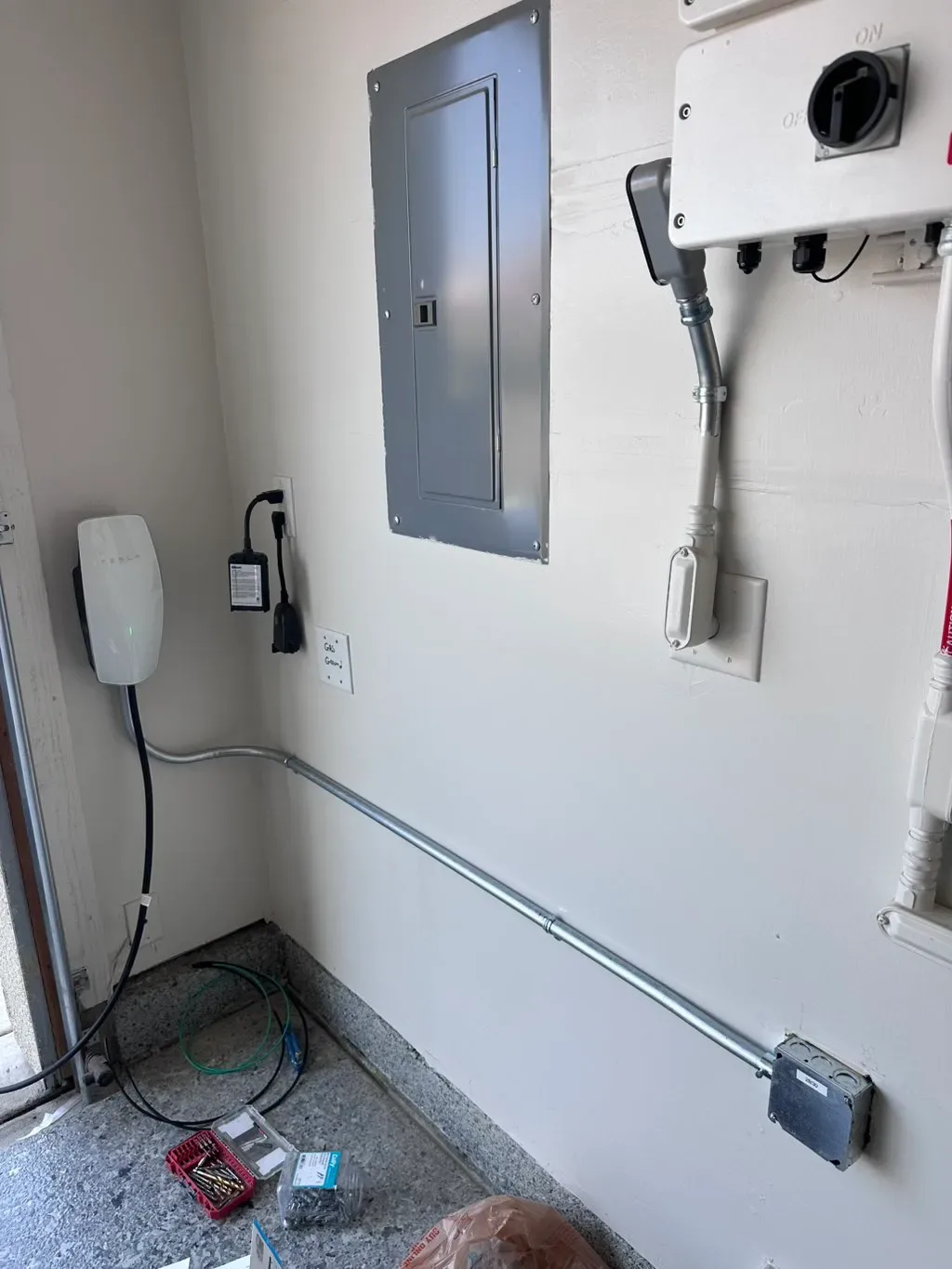
Adding an EV charger is often treated as a single-device installation. In practice, it is usually a good time to look at the garage as a whole. A modern garage may already power garage-door openers, lighting, a refrigerator or freezer, workbench tools, battery chargers, an air compressor, a shop vacuum, a water heater, laundry equipment, storage systems, smart-home equipment, and exterior lighting. Add one EV — and eventually a second — and the electrical plan can change significantly.
For Sacramento-area homeowners, the better question is not simply whether a charger can be installed here. It is what the garage electrical system should look like if EV charging is one of several present and future loads. Plan in this order:
charging need → charger location → circuit and load calculation → second-EV strategy → garage loads → subpanel or feeder → future pathways → finishes last
EV-ready garage electrical upgrades at a glance
| Item | Planning baseline |
|---|---|
| Charging method | 120V or 240V; size to actual daily driving, not the charger’s maximum |
| Circuit | Dedicated; sized to the configured charging current as a continuous load |
| Hardwired vs receptacle | Both can be appropriate; follow the charger listing and installation method |
| Panel space | Separate from service capacity; an empty breaker space is not a capacity answer |
| Service upgrade | Not automatic; a lower rate or listed load management may fit |
| Second EV | Plan now; two vehicles do not automatically need two full-power circuits |
| Subpanel | Useful for garage distribution; does not create electrical capacity |
| Attached vs detached | A detached garage is often a feeder, trench, subpanel, and grounding project |
| Permit | New charging circuits and distribution changes are permit work |
Choose the charging method before sizing the circuit
The first decisions are how the household actually charges, whether that is 120V or 240V, how much current is useful, and whether the equipment is hardwired or receptacle-fed.
Start with the charging goal. Before deciding what circuit to install, define how the vehicle will actually be charged: which EV or plug-in hybrid, how many miles are normally driven per day, whether charging happens overnight, whether a second EV may be added, whether the charger will be hardwired or receptacle-fed, where the vehicle parks and where a future vehicle might park, whether the garage is attached or detached, and whether other large electrical loads are being added. A household that drives 25 miles per day has a different charging requirement from one that routinely returns home with a nearly depleted battery. The electrical installation should fit the actual charging need.
Level 1 and Level 2 are very different electrical projects. Residential EV charging is commonly discussed in two broad categories. 120V charging may use an existing or dedicated 120V receptacle, depending on the equipment and circuit. It can be sufficient for plug-in hybrids, low daily mileage, vehicles parked for long periods, and households that do not need fast overnight replenishment. The advantage is that the electrical demand is relatively modest. The limitation is charging speed. 240V charging can deliver substantially more charging power and is common for homeowners who want reliable overnight charging. Depending on the charger and vehicle, the branch circuit may represent one of the larger new loads in the house. That makes panel capacity and load calculation much more important.
Do not size the garage around the maximum charger just because it exists. A common mistake is to assume that the “best” EV installation is always the largest circuit the charger or vehicle can accept. That is not necessarily true. The useful question is how much charging power this household actually needs. A lower charging rate may still replace the household’s normal daily driving overnight — which can matter when panel capacity is limited, service upgrades would be expensive, a second EV may be added later, other electrification projects are planned, or dynamic load management is an option. The goal is not to maximize amperage for its own sake. The goal is to build a charging system that works reliably within the home’s electrical constraints.
Hardwired EV charger vs. receptacle-fed charging. Some EV chargers are hardwired directly to a dedicated branch circuit. Others connect through a receptacle. Both can be appropriate when the equipment and installation are designed for that method. The choice affects receptacle requirements, connection points, installation complexity, serviceability, equipment location, GFCI requirements where applicable, enclosure and environmental requirements, and future charger replacement. A hardwired installation eliminates the plug-and-receptacle connection and is common for permanent EV charging equipment. A receptacle-fed installation can provide flexibility, but the receptacle, branch circuit, equipment, and installation still need to be suitable for EV charging. The decision should follow the charger listing, manufacturer instructions, applicable code, and homeowner use case.
EV charging is a continuous electrical load. EV charging can operate for hours at a time, and that matters for circuit design. The branch circuit, overcurrent protection, conductors, charger setting, and equipment must all be sized for the actual charging configuration. This is not an area for guessing from the charger’s marketing maximum. The installed EVSE should be configured so the charging current matches the branch circuit and electrical design.
Does an EV charger need a panel or service upgrade?
An unused breaker space is not a capacity answer. The service rating, existing loads, equipment condition, and whether load management is appropriate all have to be evaluated together.
Panel capacity matters more than empty breaker space. An unused breaker position does not prove that the house can support another large load. Two separate questions have to be answered: is there physical room for the new circuit, and does the service have enough capacity for the additional load? The second question is usually more important. A panel may have open spaces while the home already carries significant loads from air conditioning, an electric range, an electric dryer, electric water heating, pool or spa equipment, a sauna, electric heat, another EV charger, or other large dedicated loads. An electrician may need to perform the appropriate load calculation before choosing the charging circuit.
A 200A service does not automatically mean “no problem.” A 200-amp service is common, but the service rating alone does not answer whether a given EV charging load can be added. Two 200A homes can have very different electrical demand. One may have a gas range, gas water heater, gas furnace, and modest household loads. Another may have an electric range, heat pump, electric water heater, pool equipment, hot tub, sauna, and one existing EV charger. The load calculation is what distinguishes those houses electrically.
A panel upgrade is not always the first answer. If the existing service does not comfortably support the desired charging load, a panel upgrade or service upgrade may be appropriate. But it is not the only possible strategy. Depending on the home and equipment, options may include reducing EV charging current, scheduling charging, dynamic load management, sharing capacity between two EV chargers, coordinating with other large loads, or installing a larger service where justified. The correct approach depends on the electrical system and household goals. The expensive answer should not be assumed before the load problem is actually defined.
Dynamic load management can change the project. Load-management systems can allow EV charging to respond to the home’s real-time electrical demand. In a simplified example, the EV charger may reduce charging power when the house is using more electricity and increase charging when capacity is available. That can be useful where the service has limited available capacity, the household wants faster charging without a major service upgrade, another large load operates intermittently, or a second EV is being planned. Whether a specific load-management system is appropriate depends on charger compatibility, service configuration, listed equipment, installation requirements, and applicable electrical rules. It should be treated as engineered electrical equipment, not as a software workaround.
Panel condition matters, not just panel rating. An EV project can expose problems that existed before the charger was considered. An electrician may find damaged breakers, overheating, corrosion, limited breaker compatibility, crowded wiring, outdated equipment, improper previous modifications, or inadequate feeder arrangements. A panel does not need replacement merely because it is old. But the condition of the equipment matters when a substantial new continuous load is being added.
Plan the second EV, subpanel, and attached vs detached garage
The first charger should not lock in a one-car layout. Distance, feeder design, and whether a second vehicle is likely all change the distribution plan.
Plan for the second EV before installing the first. Many households buy one EV and design the garage around one parking space. Then the second vehicle changes. If there is a realistic chance of a second EV, think about it now. That can affect charger location, raceway routing, conductor pathway, panel space, load management, subpanel sizing, wall layout, and parking orientation. A small amount of planning during the first installation can avoid reopening finished walls later.
Two EVs do not necessarily require two full-power circuits. A two-EV household does not automatically need two chargers operating at maximum output simultaneously. Depending on the vehicles, driving patterns, and equipment, the charging plan may use two independent circuits, two chargers that share available power, sequential charging, managed charging, one higher-power charger used by both vehicles, or different charging rates for each vehicle. The useful metric is whether both vehicles are ready when needed. That is different from asking whether both can charge at maximum power at the same time.
Garage subpanels can make sense in larger projects. A subpanel may be useful when the garage is becoming a more heavily electrified space. Possible garage loads may include EV charging, workshop tools, an air compressor, lighting, a refrigerator or freezer, laundry, a water heater, HVAC, exterior circuits, and a future second EV. A garage subpanel can centralize branch circuits and make future expansion more practical. But installing a subpanel does not create electrical capacity by itself. The feeder and upstream service still have to support the loads.
Attached and detached garages are different projects. An attached garage may be relatively close to the main panel. A detached garage can require feeder evaluation, trenching or exterior raceway, a subpanel, grounding and bonding, underground wiring methods, physical protection, weather-rated equipment, and detached-structure considerations. Distance also matters. Long feeder or branch-circuit runs can affect conductor selection, voltage-drop considerations, routing, and cost. A detached garage should be evaluated as an electrical distribution project, not just an EV charger location.
What else in the garage needs power?
EV charging is one garage load. The rest of the space still has to work.
Existing garage receptacles may not be suitable for EV charging. Just because a receptacle exists does not mean it should be used for long-duration EV charging. An electrician may need to check circuit rating, what else is connected, receptacle and wiring condition, grounding, breaker protection, whether the circuit is dedicated where required, and whether the charging equipment permits that connection. Older garages may have receptacles that were installed for occasional tool use, not hours of sustained charging. The charging method should match the actual circuit.
Workshop tools should be part of the plan. An EV-ready garage is often also a workshop. Common loads include a table saw, miter saw, air compressor, welder, dust collector, shop vacuum, battery chargers, bench tools, and power-tool chargers. Some are small intermittent loads. Others can have substantial starting or operating current. If the garage already has a workshop, the EV installation should be planned around it rather than pretending the charger is the only load in the space.
Refrigerator and freezer circuits are easy to overlook. Garage refrigerators and freezers are common. They matter because they are expected to operate continuously and because nuisance trips can lead to spoiled food. During a garage electrical upgrade, consider what circuit they are on, whether that circuit is shared, receptacle condition, GFCI requirements, and whether backup-power planning is relevant. The goal is not to overbuild the garage. It is to understand which loads are important and which ones can tolerate interruption.
Garage-door openers need reliable power. Garage-door openers are usually modest loads, but they are essential equipment. A remodel that relocates ceilings, storage systems, lighting, or EV equipment should not make opener access or power worse. Plan around opener receptacle location, ceiling-mounted storage, lighting conflicts, future opener replacement, backup battery systems, and smart controls. The charger should not be installed where its cable interferes with door tracks, vehicle access, or opener equipment.
Lighting often deserves an upgrade at the same time. Garages are frequently underlit. If walls or ceilings are already open for electrical work, it may be a good time to improve general ceiling lighting, workbench lighting, storage-area lighting, exterior lighting, occupancy controls, and switch locations. Good lighting matters even more when the garage is used for charging, maintenance, workshop tasks, storage, detailing, or home gym use. EV charging is often the project that exposes how little attention the rest of the garage electrical system has received.